
No products in the cart.
Return To Shop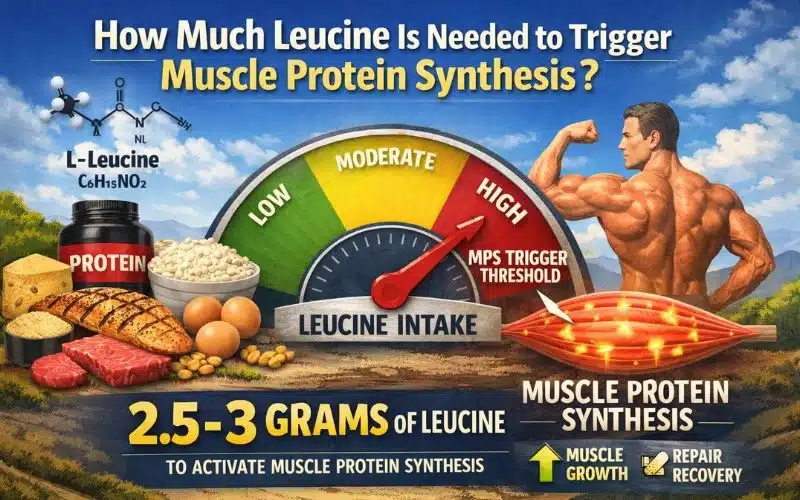
How Much Leucine Is Needed to Trigger Muscle Protein Synthesis
Most people who train seriously know that protein matters for muscle growth, but the conversation gets far more interesting when you zoom in on one specific amino acid that acts as the on switch for the entire muscle-building process. Leucine is not just another building block , it is the primary anabolic signal that tells the body it is time to start building and repairing muscle tissue.
The Leucine Threshold:What the Research Actually Shows
The concept of a leucine threshold is central to understanding muscle protein synthesis at a mechanistic level. Research consistently points to a minimum of 2 to 3 grams of leucine per meal as the amount needed to maximally activate the mTOR signalling pathway, which is the molecular switch that initiates muscle protein synthesis. Below this threshold, the anabolic signal remains subthreshold , meaning the body receives some stimulation but not enough to drive a full synthetic response.
- At around 1.8 grams of leucine, partial mTOR activation occurs but synthesis rates remain blunted
- The 2.5 gram mark appears to be where most research identifies peak anabolic signalling in healthy adults
- Beyond 3 to 4 grams per meal, there is diminishing return , the pathway is already maximally stimulated
- Older adults over 60 often require closer to 3 to 4 grams due to anabolic resistance that develops with age

Why Leucine Specifically Acts as the Anabolic Trigger
Leucine is sensed directly by a cellular protein complex called mTORC1, which acts as a nutrient sensor within muscle cells. When leucine levels rise in the bloodstream after a meal, mTORC1 activates downstream targets that initiate the actual machinery of protein synthesis , including the ribosomal protein S6 kinase and the translation initiation factor 4EBP1.
The other two branched-chain amino acids, isoleucine and valine, do not share this direct sensing mechanism. You can read more about what BCAAs are and their broader roles in muscle and energy metabolism, but from a purely anabolic signalling standpoint, leucine is the driver. That said, leucine cannot complete the synthesis process alone , it needs the full spectrum of essential amino acids to actually build muscle protein, which is a distinction that becomes very practical when choosing supplements.
Leucine Content Across Common Protein Sources
One of the most useful applications of understanding the leucine threshold is being able to evaluate different protein sources based on their leucine delivery per serving, not just their total protein content. This changes how people should think about meal planning and supplementation.
Whey protein is consistently ranked as the highest-leucine protein source available, containing approximately 10 to 11 percent leucine by weight. A standard 25-gram serving of whey protein delivers roughly 2.5 to 2.7 grams of leucine , placing it right at or above the threshold with a single serving.
- Whey protein isolate: approximately 2.6 to 2.8 grams of leucine per 25g serving
- Whey protein concentrate: approximately 2.3 to 2.5 grams per 25g serving
- Casein protein: approximately 1.7 to 2.0 grams per 25g serving , often requires a larger dose
- Egg white protein: approximately 2.0 to 2.2 grams per 25g serving
- Chicken breast: approximately 1.9 to 2.1 grams per 100g serving
- Plant proteins such as rice or pea: typically 1.5 to 2.0 grams per 25g serving, often requiring leucine fortification
Why Plant Proteins Often Fall Short of the Leucine Threshold
Plant-based athletes and vegetarians face a specific challenge that the leucine threshold makes very clear. Most plant protein sources , including pea, rice, hemp, and soy , have a lower leucine concentration per gram of protein than animal-based sources. This does not make plant proteins useless, but it does mean that larger serving sizes or strategic blending of multiple plant proteins is required to consistently hit the 2.5-gram leucine target per meal.
Vegan protein shake recipes that combine pea and rice protein are a practical solution because the two proteins have complementary amino acid profiles, and together they can approach the leucine density of whey when portioned correctly. The goal for plant-based athletes should be aiming for 30 to 40 grams of combined plant protein per meal to reliably clear the leucine threshold rather than the 20 to 25 grams that suffices for whey.
The Relationship Between Total Protein Intake and Leucine Dosing
Leucine threshold science does not exist in isolation from overall daily protein targets. Someone eating adequate total protein across well-distributed meals will naturally accumulate sufficient leucine exposures throughout the day, assuming they are choosing quality protein sources. The problem arises when meals are protein-sparse or dominated by lower-quality protein sources that do not deliver enough leucine per serving.
How much protein you need per day as a beginner is a foundational question that directly influences how many leucine threshold crossings happen in a given day. Most research on maximising muscle protein synthesis suggests three to four protein-rich meals per day, each meeting the leucine threshold, rather than front-loading all protein in one or two sittings. This meal distribution strategy keeps synthesis rates elevated more frequently throughout the day.
Leucine in the Context of Post-Workout Nutrition
The window immediately after resistance training is when the muscle is most sensitised to leucine’s anabolic signal. During and shortly after exercise, mTOR signalling capacity in muscle increases, meaning the same amount of leucine produces a stronger synthetic response than it would at rest. This is the physiological basis for prioritising post-workout nutrition with high-leucine protein sources.
- Post-workout is the highest-leverage time to hit the leucine threshold
- Whey protein is particularly effective post-workout due to its rapid digestion and high leucine content
- Consuming 25 to 30 grams of whey protein post-workout reliably delivers 2.5 to 3.0 grams of leucine
- Adding leucine-rich foods like chicken or eggs to the post-workout meal amplifies and extends the anabolic signal
The speed of leucine delivery matters here too. Hydrolysed or isolated forms of isolated protein absorb faster than concentrates, creating a sharper leucine spike in the bloodstream that may produce a more robust mTOR activation post-training.
Leucine Supplementation as a Strategy for Older Adults
Ageing introduces a frustrating dynamic called anabolic resistance , the blunted response of muscle protein synthesis to both exercise and amino acid stimulation. Older adults require more leucine to achieve the same anabolic signal that younger adults get from lower doses. This is not a minor variation; studies suggest the leucine threshold in individuals over 65 may be as high as 3.5 to 4 grams per meal.
Standalone leucine supplements or leucine-enriched protein blends have been studied specifically for this population as a way to overcome anabolic resistance without requiring impractically large food volumes. For older adults who struggle to eat large protein portions, adding a leucine bolus of 1 to 2 grams to a protein-containing meal can effectively push total leucine delivery above the elevated threshold needed for a meaningful synthetic response. Combined with consistent strength training, strategic leucine dosing becomes one of the most practical tools for preserving muscle mass through the ageing process.

Practical Leucine Dosing for Different Goals
Translating leucine threshold science into real daily decisions is what makes this knowledge genuinely useful rather than theoretically interesting. The application looks different depending on someone’s goal, training status, and dietary approach.
For muscle building during a caloric surplus, the priority is ensuring every major meal clears the leucine threshold, and the total daily protein target is met across three to four feeding occasions. High protein foods for weight gain that are also leucine-rich , such as chicken, eggs, dairy, and quality protein supplements , should form the backbone of the diet.
- Muscle building: aim for 2.5 to 3 grams of leucine per meal, three to four meals daily
- Fat loss with muscle preservation: maintain leucine threshold at every meal even in a caloric deficit , this is non-negotiable for preventing muscle loss
- Athletic performance: prioritise post-training leucine delivery within 30 to 60 minutes of finishing a session
- Older adults: target the upper range of 3 to 4 grams per meal and consider leucine-enriched supplements
Choosing Supplements That Reliably Deliver the Leucine Threshold
Not all protein supplements are created equal from a leucine delivery standpoint, and label transparency varies widely across the market. When evaluating a supplement, the amino acid profile , specifically the leucine content per serving , is the most important number to check, not just the total protein per serving.
Whey protein for beginners is often recommended precisely because it consistently delivers above-threshold leucine in a standard serving without needing to dose excessively. For anyone comparing options, amino acid supplements and standalone EAA products can also be used strategically to boost leucine delivery during meals that are naturally lower in animal protein , a particularly useful tool for vegetarians, intermittent fasters, or anyone in a caloric deficit who cannot always eat large protein portions.
The science of leucine and muscle protein synthesis is one of the clearest areas in sports nutrition research. Two to three grams per meal is the threshold, quality protein sources are the most reliable way to hit it consistently, and the post-workout window is the highest-leverage moment to prioritise it. That single framework, applied consistently, can meaningfully accelerate the muscle-building results that training alone cannot produce.

Related posts

Fast cardio has a loyal following among fat-loss enthusiasts, and for good reason , training on an empty stomach pushes the body to tap into... Continue reading

Lahore is the food capital of Pakistan. From weekend breakfast Halwa Puri and Channa in Anarkali to late-night Karahi and Naan in Lakshmi Chowk, our... Continue reading

Starting your fitness journey is an exciting milestone. Whether you are hitting a local gym in Gulberg, DHA, or Johar Town, the goal is always... Continue reading

If you’ve ever looked in the mirror and felt like you’re somehow both too thin and carrying too much fat you’re not imagining it. The... Continue reading
One of the most persistent myths in nutrition is that getting a complete amino acid profile is impossible on a plant-based diet. That claim was... Continue reading
Add comment