
No products in the cart.
Return To Shop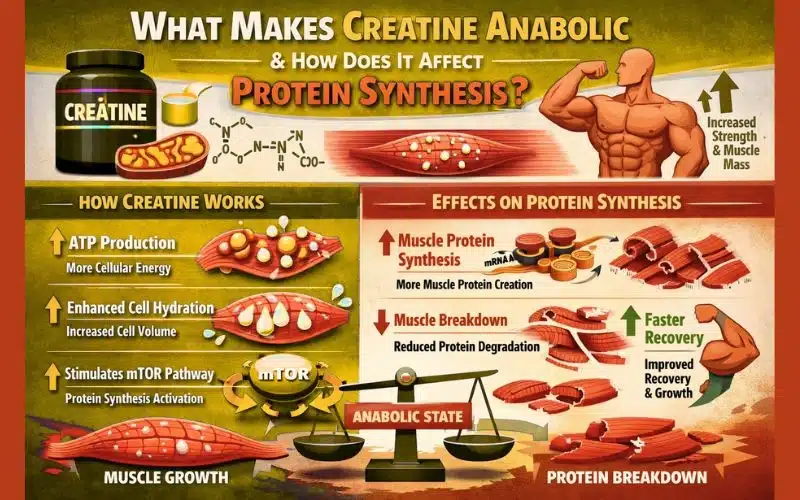
What Makes Creatine Anabolic and How Does It Affect Protein Synthesis
The word anabolic gets thrown around a lot in the supplement world, often as a marketing label rather than a precise biological claim. But when it comes to creatine, the anabolic label is genuinely earned , and the mechanisms behind it are more layered than most people realise. Creatine does not directly inject amino acids into muscle fibres or mimic hormones. What it does instead is reshape the internal environment of muscle cells in ways that make protein synthesis more efficient, more sustained, and more responsive to training.
The Anabolic Definition: What It Actually Means
Anabolic refers to any biological process that builds up complex molecules from simpler ones , in the context of muscle, it describes the construction of new muscle protein from individual amino acids. A compound is anabolic when it creates or amplifies the conditions under which this building process accelerates. That can happen through multiple pathways: raising anabolic hormone levels, increasing the availability of the raw materials for protein synthesis, activating the molecular signalling cascades that trigger it, or simply reducing the rate of muscle protein breakdown that would otherwise cancel out new growth.
Creatine operates across several of these pathways simultaneously, which is what gives it a genuine anabolic classification rather than a purely ergogenic one.
The ATP Connection: Energy as the Gateway to Anabolism
Every anabolic process in the body runs on energy , specifically adenosine triphosphate, or ATP. Muscle protein synthesis is energetically expensive. The ribosomal machinery that reads mRNA and assembles amino acids into protein chains requires a continuous ATP supply to function. When cellular energy is limited, protein synthesis is one of the first processes the body downregulates in favour of more immediately critical functions like maintaining membrane potential and fuelling basic cellular repair.
Creatine solves this problem at its root. By saturating muscles with phosphocreatine, it dramatically expands the cell’s ability to rapidly regenerate ATP through the phosphocreatine energy system. This keeps ATP availability high not just during explosive training efforts but during the recovery and synthesis window that follows. More available ATP means the cell can run both muscle repair and new muscle protein synthesis at full capacity simultaneously , rather than rationing energy between the two. For the complete breakdown of how creatine monohydrate benefits and usage translate to real training outcomes, the science is consistent: more phosphocreatine means more total anabolic work per training session.
How Creatine Activates the mTOR Signalling Pathway
The mTOR pathway , mechanistic target of rapamycin , is the central switch that governs muscle protein synthesis in response to both training and nutrition. When mTOR is activated, ribosomes ramp up production of muscle proteins. When it is suppressed, synthesis slows and catabolism can dominate. Leucine from dietary protein is the most well-known mTOR trigger, but creatine also activates this pathway through a distinct and complementary mechanism.
Research published in the Journal of Physiology demonstrated that creatine supplementation combined with resistance training produced significantly greater mTOR pathway activation than resistance training alone. The proposed mechanism involves creatine-induced cell swelling , a hydraulic pressure effect inside the muscle cell that the cell membrane detects and interprets as a mechanical signal. This swelling triggers the same downstream signalling cascade as mechanical loading from training, amplifying the overall mTOR response beyond what exercise alone produces.
- Creatine increases intracellular water content, creating a state of cell volumisation
- The swollen cell membrane sends a hypertrophic signal through osmotic sensing mechanisms
- This activates mTOR and its downstream targets S6K1 and 4E-BP1 , the specific proteins that regulate ribosomal activity and translation initiation
- The result is an amplified protein synthesis response that stacks on top of the leucine-driven signal from dietary protein
This is one reason why the combination of creatine and high-protein intake produces greater lean mass gains than either alone. Pairing creatine with a quality whey protein source covers both mTOR triggers simultaneously , leucine from whey and cell swelling from creatine , creating a dual anabolic signal at the same time.
Creatine and Satellite Cell Activation
Beyond mTOR, creatine has a documented effect on satellite cells , the muscle stem cells that are responsible for adding new myonuclei to muscle fibres. Myonuclei are the control centres within each muscle fibre, and more of them means a greater capacity for that fibre to produce contractile proteins and grow larger. This is one of the most significant long-term anabolic mechanisms that creatine influences.
Multiple studies have shown that creatine supplementation increases the activation and proliferation of satellite cells in response to resistance training, resulting in a greater number of myonuclei per muscle fibre compared to training without creatine. This is not a temporary water-retention effect , it represents a structural change in the muscle that persists even after creatine is discontinued, contributing to what researchers describe as a permanent expansion of the muscle’s growth potential.
- Satellite cells normally sit dormant at the periphery of muscle fibres, activated only by significant mechanical damage or overload
- Creatine lowers the threshold for satellite cell activation, meaning more of them respond to each training session
- Each newly donated myonucleus expands the fibre’s synthetic capacity , more nuclei can transcribe more mRNA and produce more contractile protein
- This mechanism explains why creatine users often retain a disproportionate amount of their lean mass gains even during off-cycle periods
The IGF-1 Amplification Effect
Insulin-like growth factor 1 (IGF-1) is one of the primary anabolic hormones produced locally in muscle tissue in response to mechanical loading. It stimulates both protein synthesis and satellite cell activity, making it a central driver of hypertrophy. Research has shown that creatine supplementation elevates local muscle IGF-1 expression above the levels achieved by training alone , a finding that directly connects creatine use to hormonal anabolism rather than purely mechanical or energetic effects. The article on benefits of strength training covers how resistance training itself drives this IGF-1 response, and creatine amplifies that same hormonal cascade.
This IGF-1 elevation happens within the muscle tissue itself , it does not reflect a systemic hormonal change detectable in bloodwork, which is why creatine avoids the hormonal side effects associated with anabolic steroids while still producing a genuine anabolic hormonal signal at the tissue level. It is a localised, training-driven amplification rather than a systemic hormone manipulation.
Creatine and Myosin Heavy Chain Expression
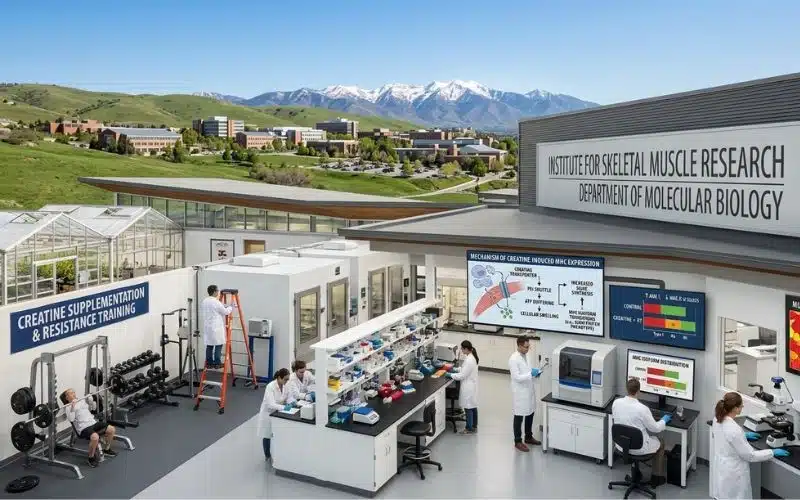
Myosin heavy chain (MHC) proteins are the primary contractile proteins in fast-twitch muscle fibres , the fibres most responsible for producing force and growing in response to resistance training. Studies have demonstrated that creatine supplementation increases the rate of MHC protein synthesis, effectively accelerating the production of the structural components that make muscles stronger and larger. This effect operates through the mTOR pathway described earlier but represents a specific end-point outcome: the actual contractile machinery of the muscle fiber is being built faster. For athletes pursuing lean muscle specifically , dense, functional muscle rather than volume from glycogen or water , this MHC-specific synthesis acceleration is one of the most relevant anabolic mechanisms creatine offers.
Anti-Catabolic Effects: The Other Side of Net Muscle Growth
Net muscle growth is not just about how fast protein is synthesised , it is the balance between synthesis and breakdown. Creatine addresses the breakdown side of this equation through several mechanisms, making it genuinely anti-catabolic in addition to its direct anabolic effects.
- Myostatin suppression: creatine has been shown in research to reduce myostatin expression in muscle tissue. Myostatin is the protein that limits muscle growth , it acts as a brake on hypertrophy. Lower myostatin means fewer restrictions on how much the muscle can grow
- Cortisol blunting: intense training elevates cortisol, the catabolic stress hormone that accelerates muscle protein breakdown. Some research suggests creatine supplementation attenuates the cortisol response to high-volume training, reducing the catabolic signal that would otherwise limit net anabolism
- Cell volumisation reducing apoptosis: the same cell swelling that activates mTOR also appears to suppress muscle cell apoptosis , programmed cell death , keeping a greater proportion of trained muscle fibres viable and growing
These anti-catabolic mechanisms mean creatine’s net effect on protein balance is even more positive than the direct synthesis data suggests. The combined picture , more ATP for synthesis, mTOR activation, satellite cell proliferation, IGF-1 elevation, MHC acceleration, and myostatin suppression , explains why creatine consistently outperforms almost every other supplement in head-to-head studies on lean mass gain.
Protein Synthesis Timing: When Creatine Matters Most
The anabolic effects of creatine are not equally distributed across the day. The post-workout period is when protein synthesis is most elevated, ATP demand for repair is highest, and mTOR signalling is most responsive to additional stimuli. Taking creatine around the training window , particularly post-workout alongside a fast-digesting protein source , aligns creatine delivery with the period of peak anabolic sensitivity. The guide on post-workout nutrition and whey protein covers the broader nutrition strategy that creatine should sit within.
For those using anabolic creatine formulas that include fast carbohydrates, the timing logic is even more specific: the carbohydrate-induced insulin spike accelerates creatine transport into muscle cells precisely when they are most depleted and receptive. This is why anabolic creatine products are typically consumed immediately post-workout rather than at arbitrary times throughout the day.
- Post-workout: optimal window for creatine absorption due to depleted phosphocreatine stores and elevated GLUT4 transporter activity
- Pre-workout: second-best window, ensuring phosphocreatine stores are topped up before training begins
- Any consistent daily time: for plain monohydrate, consistency of use matters more than precise timing , muscle saturation is the goal, not acute spikes
Choosing the Right Creatine for Maximum Anabolic Impact
An anabolic blend adds the insulin-mediated uptake acceleration, amino acid co-delivery, and in some formulations beta-alanine for extended training volume. Both are legitimate , the question is whether the additional components align with the training phase and nutritional context.
For verified product options, the creatine category at Sports One covers the full range from plain monohydrate to advanced anabolic blends, all sourced from authenticated international brands through the authorised distribution network.
For anyone building a complete muscle-growth stack, understanding how creatine interacts with dietary protein is equally important. The article on best proteins for muscle gain , whey casein or blends explains how to structure the protein component that creatine’s anabolic mechanisms depend on to produce their full effect. Creatine amplifies the anabolic environment , protein provides the raw materials that environment is designed to build with.
Related posts
Most fitness goals fit neatly into one of two camps: bulking or cutting. But a growing number of athletes, natural lifters, and everyday gym-goers want... Continue reading
Most people walk into the gym, train hard, and then reach for a single scoop of whey right after. That routine works , but it... Continue reading

If you have been searching for a protein supplement that actually supports fat loss while keeping your hard-earned muscle intact, clear whey isolate might be... Continue reading
For Pakistani women struggling with being underweight, the journey to healthy weight gain can feel overwhelming. Between cultural expectations, busy schedules, and conflicting nutrition advice,... Continue reading

Joint pain has become increasingly common among Pakistanis, affecting people across all age groups, from young athletes recovering from injuries to elderly individuals dealing with... Continue reading
Add comment