
No products in the cart.
Return To Shop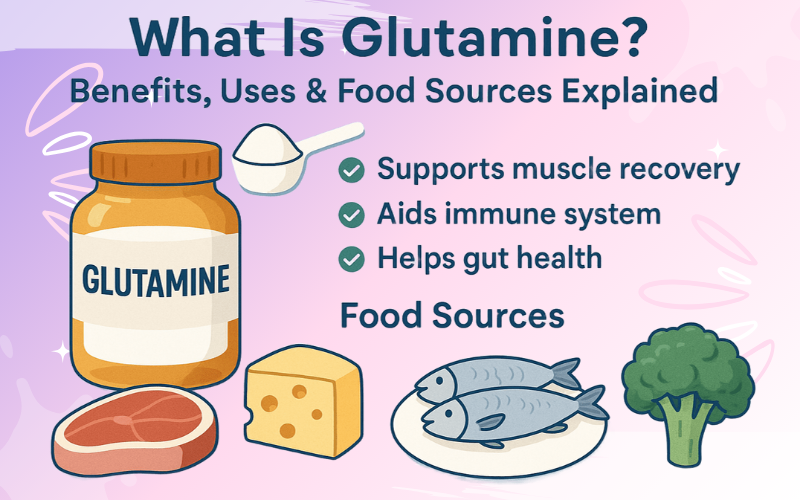
What Is Glutamine? Benefits, Uses & Food Sources Explained
Last updated: September 2026
If you’re researching imported supplements in Pakistan, glutamine is a useful place to start. It ranks among the common imported amino acid supplements available in the local market and shows what buying an imported product involves, from brand sourcing and authenticity checks to PKR pricing.
This guide first explains what imported supplements are and how you can buy them safely in Pakistan. It then focuses on glutamine, covering what it is, how it works, its potential benefits, and how much you may need.
What Are Imported Supplements in Pakistan?
An imported supplement comes from a manufacturer outside Pakistan, typically in the US, UK, or Europe. Licensed importers or distributors then bring these products into Pakistan instead of producing them locally. This distinction matters for three key reasons: the manufacturer follows standards from its home market, the longer supply chain makes authenticity and storage more important, and exchange rates and import expenses influence the final price.
Local manufacturers can also produce high-quality supplements, so buyers should not assume that imported products automatically offer better quality. People who specifically search for imported brands often want one of three things: an established international brand reputation, access to third-party testing standards, or a specific formulation, such as a particular amino acid or protein blend that local manufacturers may not offer.
Popular Imported Supplement Categories
The imported-supplement market in Pakistan spans several categories, each with its own buying considerations:
- Whey protein — the largest category, covering concentrate, isolate, and hydrolyzed formats
- Creatine monohydrate — the dominant, most-researched performance supplement
- Mass and weight gainers — high-calorie blends for people struggling to gain weight through diet alone
- Pre-workouts — stimulant and energy blends taken before training
- BCAA and amino acid supplements — including glutamine, aimed at recovery and muscle preservation
- Vitamins and minerals — general health support, often overlooked next to performance products
Why Buyers Choose Imported Supplements
International brands built their reputations on manufacturing standards, ingredient sourcing, and formulation research that took years to establish. For buyers, that translates into predictable dosing, consistent quality between batches, and access to specific product types, like L-glutamine isolates or micronized creatine, that aren’t always available from local manufacturers. This is a large part of why imported supplements in Pakistan command a price premium over locally produced alternatives.
How to Verify Original Imported Supplements
Because imported supplements carry a price premium, they’re also a common counterfeiting target. A fake tub can mean underdosed active ingredients, contaminated fillers, or expired stock relabelled with a new date. Before buying, check five things:
- Batch/lot number and expiry date — every genuine product carries both, printed clearly
- Seal and packaging quality — sharp printing, intact inner seals, no spelling errors on the label
- QR or scratch verification code, where the brand supports it
- Seller documentation — a legitimate distributor can show import paperwork and a receipt
- Price sanity check — a price 30–50% below the going rate is a red flag, not a bargain
For a full step-by-step walkthrough, see our guide on how to verify original imported supplements in Pakistan.
Authorized Distributor vs. Random Seller
An authorized distributor holds a documented import trail: direct procurement from the manufacturer, proper storage and handling during transit, and distribution only to authorized retailers rather than open marketplace sellers. That traceability is the difference between a product you can verify and one you’re taking on faith. SportsOne International is an authorized distributor of multiple international supplement brands in Pakistan, which means every product, from glutamine to creatine to pre-workout, comes with batch tracking and authentication support.
Certifications and Quality Signals
Look for Halal certification where applicable, GMP-compliant manufacturing, and third-party testing where the brand publishes it. Certifications apply at the product or batch level, not automatically to an entire brand, so it’s worth confirming certification status for the specific product you’re buying rather than assuming it carries over from the brand name alone.
Why Imported Supplement Prices Vary in Pakistan
Imported supplement prices in Pakistan move with four factors:
- Currency exchange rate — these products are sourced in foreign currency, so PKR/USD movement directly affects landed cost
- Shipping and freight — international freight is added on top of product cost
- Import duties and taxes — these vary by category and change with policy
- Distributor margin and demand — authorized distributors with verification support typically price slightly above unauthorized sellers, and that difference is often the cost of getting a genuine product
Where to Buy Imported Supplements in Pakistan
SportsOne International is Pakistan’s Imported Supplements in Pakistan destination for authentic, Halal-certified sports nutrition, with nationwide, city-wise delivery and cash on delivery. Every listing is sourced through authorized import channels, so the batch verification steps above apply cleanly to what you’re buying.
Imported Glutamine: Where It Fits
Glutamine is one concrete example of an imported amino acid supplement, and a good one to understand in depth because it sits at the intersection of fitness recovery and general gut health. The rest of this guide covers what glutamine is, what it does, how much to take, and what it costs in Pakistan.
What Is Glutamine?
Glutamine is a conditionally essential amino acid, meaning your body can usually make enough of it except during times of extreme stress, trauma, or illness. It is the most abundant amino acid in your body, especially in muscle tissue and blood. Glutamine supports:
- Protein synthesis (muscle building)
- Immune cell function
- Intestinal barrier health
- Nitrogen transport in cells
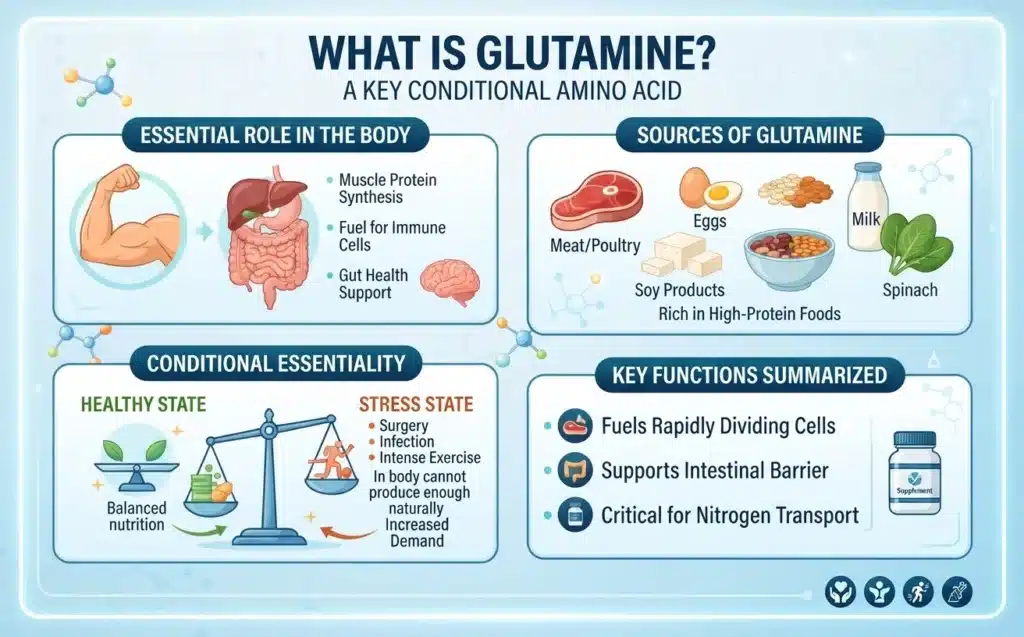
Under normal conditions, your body produces enough glutamine naturally. During physical stress, like surgery, infection, or intense exercise, demand may outpace supply.
Types of Glutamine: L-Glutamine vs. D-Glutamine
Glutamine exists in two forms. L-glutamine is the biologically active form found in food and used in supplements; it’s the form your body uses for metabolic functions, healing, and recovery. D-glutamine is structurally different and not commonly used in human biology or supplementation. When people refer to glutamine in health or fitness, they almost always mean L-glutamine.
What Does Glutamine Do for Your Body?
Muscle Recovery
Glutamine is stored in muscles and helps reduce soreness and muscle breakdown post-workout. It supports recovery and lean muscle preservation during a calorie deficit or illness.
Immune Support
It acts as fuel for white blood cells and immune-regulating cells in the gut. When you’re sick or injured, your immune system rapidly consumes glutamine.
Gut Health
Glutamine is the primary fuel for intestinal cells, helping maintain a healthy gut lining. It can reduce intestinal permeability (“leaky gut”) and support conditions like IBS.
Metabolism and Energy
Glutamine helps balance nitrogen transport in your body and is used in energy production, especially under stress or trauma.
Good Food Sources of Glutamine
| Food | Glutamine Content (approx.) |
| Beef | High |
| Chicken | High |
| Eggs | Moderate |
| Fish (salmon, tuna) | Moderate |
| Milk & yogurt | Moderate |
| Cabbage | High (for a plant source) |
| Beans & lentils | Moderate |
| Spinach | Good source |
Note: Cooking can slightly reduce glutamine content, especially in vegetables.
Who Should Supplement With Glutamine?
- Athletes with intense training loads
- Individuals recovering from surgery, injury, or infection
- People with gastrointestinal disorders (e.g., IBS, leaky gut)
- Those with autoimmune or chronic inflammatory conditions, under medical guidance
For healthy individuals, diet is usually sufficient unless under stress or medical care.
Expert Insight: Dosage, Timing, and Safety for Imported Glutamine in Pakistan
There’s no official RDA for glutamine, but the dosage question that actually matters for most buyers is whether to take it as a general-wellness maintenance dose or a higher recovery dose. From diet alone, most people get roughly 3–6g/day. For supplementation, 5g/day covers general health goals, while 5–10g/day split across two servings, one post-workout and one before bed, is the range most commonly used for athletic recovery and gut-support purposes. Medical-use dosing, up to 30g/day, is a clinical protocol used under supervision for conditions like severe burns or sickle cell anemia, and isn’t something to self-administer.
On timing: taking glutamine post-workout is the most common approach because that’s when muscle glutamine stores are most depleted, but splitting the dose, half post-workout and half at bedtime on an empty stomach, is a reasonable alternative if gut support is the primary goal rather than muscle recovery. A 300g tub at a 5g serving lasts roughly 60 servings, which is a more useful way to compare cost-per-month across imported brands than price-per-tub alone. On SportsOne’s glutamine category page, a 250g imported L-glutamine tub currently runs approximately PKR 3,500–6,000, and a 500g tub runs approximately PKR 6,000–10,000, depending on brand and current exchange-rate-driven pricing; always confirm the live listing price before publishing or purchasing, since imported pricing moves with the rupee.
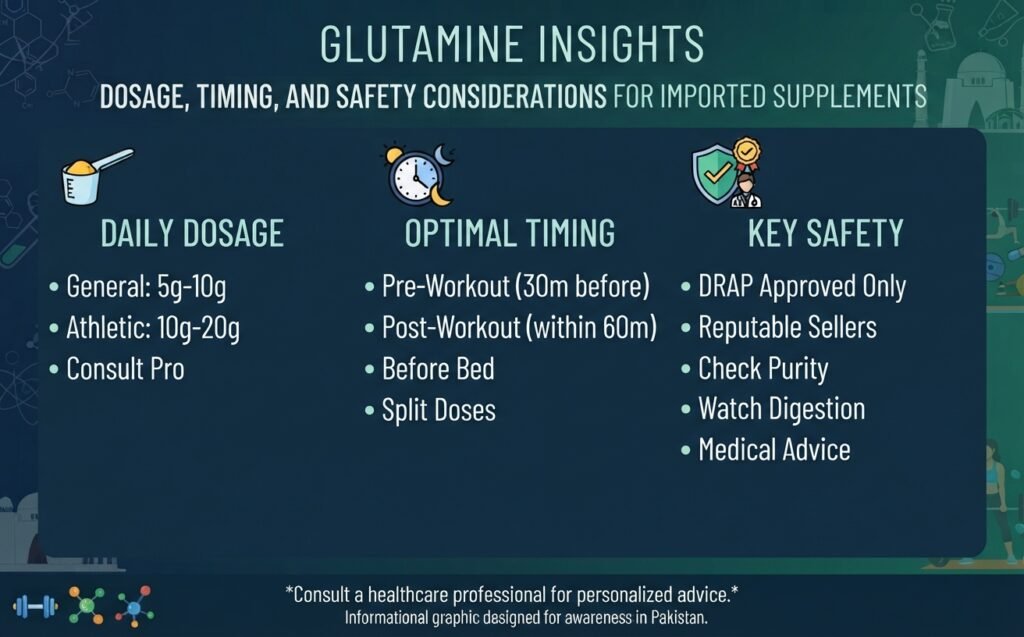
On safety: glutamine is well tolerated at standard doses, with mild GI discomfort or bloating being the most commonly reported side effect. The two genuine cautions are pre-existing liver, kidney, or seizure conditions, where a conversation with a healthcare provider is worth having before starting, and potential interaction with chemotherapy drugs, anticonvulsants, or immunosuppressants. Neither of these is specific to imported versus locally made glutamine; they apply to the compound itself, which is exactly why verifying you’re buying a genuine, correctly dosed product from an authorized distributor matters as much as the dosing protocol you follow.
Glutamine Price in Pakistan
| Pack Size | Estimated Price Range (PKR) |
| 250g L-glutamine powder | PKR 3,500 – 6,000 |
| 500g L-glutamine powder | PKR 6,000 – 10,000 |
| Capsules (60–120 count) | PKR 3,000 – 7,000 |
Estimate based on SportsOne’s glutamine category listing as of September 2026; prices move with exchange rates and import costs, so confirm the live listing before publishing.
Is Glutamine Safe? Side Effects & Warnings
L-glutamine is generally safe for most people at standard doses. Possible side effects include nausea or upset stomach, bloating or gas, and headache in rare cases. Avoid use, without medical guidance, if you have liver disease, kidney issues, or seizure disorders, and be aware it may interact with chemotherapy drugs, anticonvulsants, or immunosuppressants.
What Does Research Say?
Clinical research links glutamine supplementation to stronger post-surgery immune response, reduced gut permeability, and faster recovery from exercise-induced muscle damage. More large-scale human studies are still needed to confirm long-term effects in healthy populations.
Conclusion
Buying imported supplements in Pakistan comes down to three things working together: a genuine product, sourced from an authorized distributor, at a price that reflects real import costs rather than a too-good-to-be-true discount. Glutamine is a solid example of getting that combination right — a well-researched, versatile amino acid that plays a role in muscle recovery, immunity, and gut function. Whether you’re buying glutamine or another imported category, the buying process matters as much as the product: verify it, buy it from a source that can back that up, and dose it correctly.
Frequently Asked Questions (FAQs)
Are imported supplements in Pakistan authentic?
Most sold through authorized distributors are, but counterfeiting is common enough that verification, batch number, seal, QR/scratch code where available, is worth doing before you consume any imported product.
How can I verify an original imported supplement in Pakistan?
Check the batch number and expiry date, inspect the seal and print quality, use the brand’s QR or scratch verification code if it has one, and buy from a seller who can show import documentation.
Why are imported supplements more expensive than local ones?
Because their price is built from foreign-currency product cost, international freight, import duties, and distributor margin, not just local manufacturing cost, so prices move with the exchange rate.
Is imported glutamine Halal certified?
Halal certification applies at the product and batch level rather than automatically to a whole brand, so confirm certification status for the specific glutamine product you’re buying from an authorized distributor.
What is glutamine used for?
Glutamine supports muscle recovery, gut health, and immune function, and is used clinically for sickle cell anemia and burn recovery under medical supervision.


About author

Related posts
If you are searching for how to boost testosterone naturally, the honest answer is that food, lifting, sleep and body composition do most of the... Continue reading
Walk into any gym in Lahore, Karachi, or Islamabad before 6 p.m. and you’ll spot two camps: the ones sipping black coffee from a flask,... Continue reading
If you’ve stood in a supplement store or scrolled SportsOne’s shop wondering whether to buy BCAA, whey protein, or both, you’re not alone. It’s one... Continue reading
Ask a Pakistani woman why she avoids protein shakes. One fear comes up almost every time: “Won’t it make me look like a bodybuilder?” This... Continue reading
If you’ve ever stood in front of a supplement shelf and wondered, “Is whey protein halal?” you’re not alone. This question concerns many Pakistani gym-goers... Continue reading
Add comment