
No products in the cart.
Return To Shop
Do You Need Whey Protein If You Eat Chicken Daily?
Last Updated 1 September 2026
If chicken is already a daily part of your meals, it’s natural to ask: do you really need whey protein too? This is one of the most common questions among fitness beginners, gym-goers, and health-conscious people across Pakistan who prefer whole foods over supplements. The short answer is that it depends on your protein needs, lifestyle, and consistency. This guide breaks the question down properly, and along the way covers everything you need to know about whey protein in Pakistan: what it is, the different types available, the most trusted imported brands, and how to make sure the tub you buy is genuine.
Understanding Daily Protein Needs
Protein requirements vary from person to person. A sedentary adult may do fine with around 0.8g per kg of body weight, while physically active individuals, gym-goers, or those aiming for muscle gain often benefit from 1.2 to 2.0g per kg. Meeting these targets daily matters more than the source itself. The real challenge is not where your protein comes from, but whether you’re consistently hitting your required intake, day after day, regardless of a busy work schedule or an off day at the gym.
What Is Whey Protein and How Does It Work?
Whey protein is derived from milk during the cheese-making process. It contains all nine essential amino acids, making it a complete protein source that’s easily digestible and quickly absorbed by the body. Unlike solid foods, whey requires minimal digestion, which makes it especially useful around workouts or on busy days when cooking a full meal isn’t realistic.
Types of Whey Protein
There are three primary forms of whey protein sold in Pakistan, and knowing the difference matters when you’re comparing products:
- Whey Protein Concentrate (WPC): contains low to moderate levels of fat and carbohydrates, with protein content ranging from 70% to 80% depending on processing. This is the most common and most affordable type.
- Whey Protein Isolate (WPI): a more filtered form with 90%+ protein content and minimal lactose and fat, ideal for anyone who is lactose sensitive or cutting body fat. Browse the full isolate protein range for options.
- Whey Protein Hydrolysate (WPH): pre-digested whey that’s broken down into smaller peptides for the fastest absorption of the three, often used by athletes who need rapid recovery between training sessions.
Beyond whey, the market also includes casein protein, a slow-digesting dairy protein often taken before bed, and plant-based protein for those who avoid dairy altogether.
Whey Protein Benefits
Whey protein’s popularity comes down to a few well-documented benefits:
- High leucine content: leucine is the key amino acid that triggers muscle protein synthesis, the process your body uses to repair and build muscle tissue after training.
- Fast recovery: because it digests quickly, whey delivers amino acids to your muscles faster than most whole foods, which is why it’s popular immediately after a workout.
- Complete amino acid profile: whey contains all essential amino acids, including branched-chain amino acids (BCAAs) and glutamine, which support muscle repair after strenuous exercise.
- Convenience and portion control: a single scoop gives you a known, consistent protein amount, which is harder to judge precisely with whole foods.
Protein in Chicken Breast: What You’re Really Getting
Chicken breast is one of the most efficient whole-food protein sources available in Pakistan, and there’s a good reason it shows up in almost every fitness meal plan.
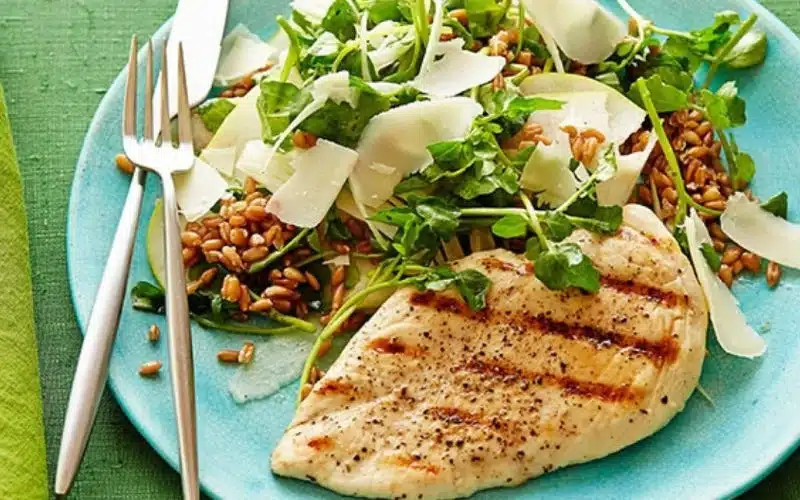
- 100g of cooked chicken breast provides roughly 30 to 31g of protein.
- It contains all essential amino acids, making it a complete protein on its own.
- It’s low in fat and calories relative to its protein content.
- It supports muscle repair and keeps you feeling full for longer.
Raw vs Cooked: Why the Numbers Change
Protein values appear higher after cooking because water content decreases, not because protein is somehow created during cooking. This is why cooked chicken looks like it has “more” protein per 100g compared to raw weight.
Food Safety Tips for Daily Chicken Eaters
Eating chicken daily means food safety becomes genuinely important over time:
- Always cook chicken to an internal temperature of 74°C (165°F).
- Avoid cross-contamination with raw meat and separate cutting boards where possible.
- Store cooked chicken properly and refrigerate promptly.
- Thaw frozen chicken in the refrigerator, never at room temperature.
Whey vs Chicken vs Other Protein Sources: Key Differences
| Factor | Chicken Breast | Eggs | Fish | Whey Protein |
| Protein per serving | ~30g / 100g | ~6g per egg | ~22g / 100g | 24 to 27g / scoop |
| Digestion speed | Slow to moderate | Moderate | Moderate | Fast |
| Convenience | Requires cooking | Requires cooking | Requires cooking | Instant, mix and drink |
| Satiety | High | High | Moderate to high | Moderate |
| Amino acid profile | Complete | Complete | Complete | Complete |
| Best used for | Main meals | Breakfast, snacking | Main meals, omega-3s | Post-workout, filling gaps |
Chicken, eggs, and fish all excel at meals, offering satiety and a wide range of micronutrients alongside their protein. Whey protein excels at filling gaps quickly, whether that’s a rushed morning, a missed meal, or the window right after training when whole food isn’t practical.
Do You Need Whey Protein If You Eat Chicken Daily?
If you consistently meet your protein needs through chicken and other whole foods, whey protein isn’t strictly necessary. However, it becomes a genuinely convenient support whenever meals or timing fall short.
When Chicken Alone Is Enough
You likely don’t need whey protein if:
- You comfortably eat enough chicken and other protein sources daily.
- You consistently hit your protein target through food alone.
- You have the time and routine to prepare meals regularly.
- Digestion of whole food protein isn’t an issue for you.
In this case, whole foods can fully support your training and recovery goals without adding a supplement.
When Whey Protein Becomes Genuinely Helpful
Whey protein becomes useful when:
- You struggle to eat enough protein through meals alone.
- Your work or study schedule is unpredictable.
- You occasionally skip meals due to time constraints.
- You train very early or very late in the day.
- Your appetite is low immediately after a hard workout.
In these situations, whey isn’t replacing chicken. It’s supporting the consistency that actually drives results.

Best Whey Protein Brands in Pakistan
Once you decide a supplement makes sense for your routine, choosing between brands is the next step. Here’s how the most searched imported whey brands compare in the Pakistani market:
- Optimum Nutrition Gold Standard 100% Whey: the world’s best-selling protein powder and the benchmark most other brands are measured against, built on a whey isolate primary blend with 24g of protein per serving.
- MuscleTech NitroTech Whey Gold: a performance-oriented isolate blend offering strong value per gram of protein, popular with regular gym-goers who want isolate-quality nutrition without ON pricing.
- Dymatize ISO-100: a hydrolyzed whey isolate designed for the fastest absorption of the major imported brands, well suited to lactose-sensitive users and aggressive cutting phases.
- Applied Nutrition Critical Whey: a UK-formulated blend of concentrate, isolate, and hydrolysed whey sourced from grass-fed cows, known in Pakistan as one of the strongest budget-to-mid-tier options for beginners.
- Kevin Levrone Gold Whey: a European import valued for its taste and mixability, offering a solid mid-range alternative to the more expensive American brands.
- Rule 1 Whey Blend: combines isolate, concentrate, and hydrolysate in one formula, a straightforward option for lifters who want a clean blended protein without paying premium isolate pricing.
- Sanaxium Nutrition Gold Whey: a halal-certified, locally distributed option that consistently offers a low cost per serving among the brands above, a strong starting point for first-time buyers.
Which brand suits you best usually comes down to budget and goal rather than any single “best” answer. If you’re testing whether a daily whey habit will actually stick, start with a smaller, lower-cost tub like Sanaxium Gold Whey or the 445g Applied Nutrition Critical Whey before committing to a 5lb premium isolate. If you’re already training consistently and want the highest protein purity per scoop, Dymatize ISO-100 or Optimum Nutrition Gold Standard are worth the higher price per serving. Regular gym-goers who want a middle ground often settle on MuscleTech NitroTech or Kevin Levrone, both of which balance taste, mixability, and cost more evenly than the ultra-premium isolates.
Whey protein prices vary by brand, size, and protein type. See our updated Whey Protein Price in Pakistan guide for current product prices.
How to Identify Original Whey Protein in Pakistan
Counterfeit and re-packed supplements are a real and persistent risk in Pakistan’s imported supplement market, especially for globally recognised names. Before buying, check for the following:
- Importer sticker: a legitimate tub carries a clearly printed importer sticker with a name and address. A missing or smudged sticker is an immediate red flag.
- Intact inner seal: the foil seal under the lid should be fully sealed and flush with the rim. A torn, loose, or oddly re-applied seal signals possible tampering or refilling.
- Batch number and expiry date: these should be embossed or clearly printed, never stickered over or smudged.
- QR code or holographic seal: brands like Optimum Nutrition and MuscleTech include scan-to-verify codes or holographic stickers on genuine stock. If a code fails to verify, do not use the product.
- Buy only from authorised distributors: purchasing your whey protein in Pakistan from an authorised, halal-certified distributor removes the guesswork, since every product is sourced through a verified import chain rather than a grey-market reseller.
Hitting Your Protein Goals: Combining Chicken and Whey
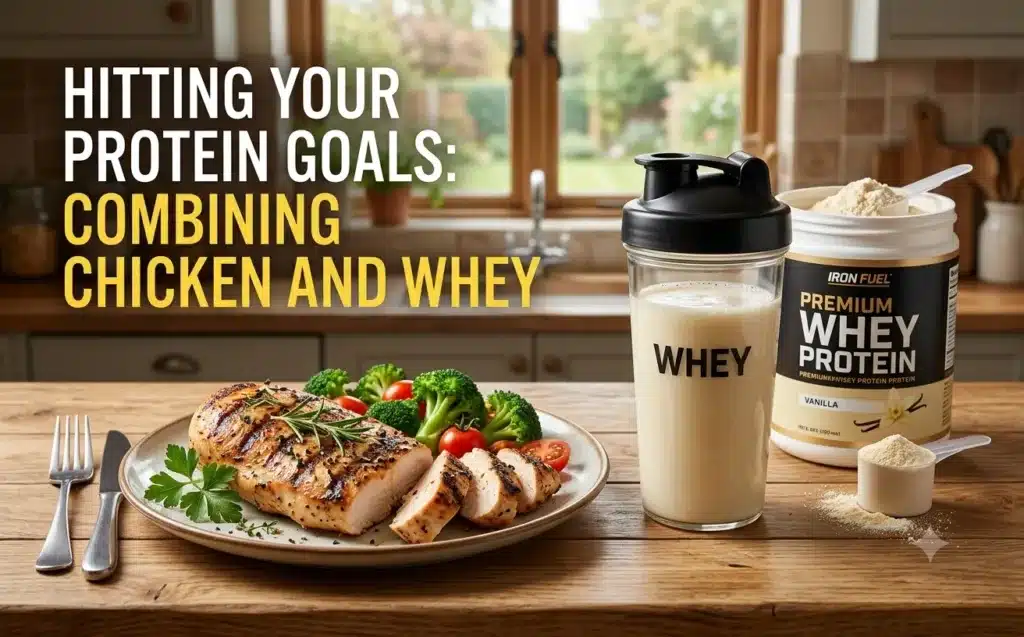
Meeting your daily protein needs is ultimately about consistency. Combining whole foods like chicken with a convenient option such as whey protein helps most people reach their targets efficiently without overcomplicating their diet.
The 25 to 40 Gram Rule Explained
Most of the muscle protein synthesis benefit from a single meal occurs in the 25 to 40g protein range. Chicken easily hits this target on its own, but spacing your protein intake evenly across the day matters just as much as the total.
How Chicken Breast Gets You There
One serving of cooked chicken breast typically covers one protein window on its own. The real issue for most people isn’t the presence or absence of whey, it’s missing meals altogether during a busy day.
A Practical Combination
Many people in Pakistan settle into a simple pattern: chicken and other whole foods for main meals, and whey between meals or immediately post-workout when time or appetite is limited. This combination improves adherence without requiring you to overthink your nutrition every day. Once your routine is consistent, some lifters also add a basic creatine supplement or a scoop of BCAA around training, though neither is necessary before your protein and meal timing basics are solid.
Common Mistakes to Avoid
- Relying only on chicken while ignoring total daily calories.
- Overcooking chicken until it becomes dry and harder to digest comfortably.
- Estimating portion sizes instead of weighing chicken, especially early on.
- Counting heavily processed chicken products, like nuggets or deli slices, as clean protein sources.
- Buying whey protein from an unverified seller purely because it’s cheaper, without checking authenticity markers first.
These mistakes, not the presence or absence of whey protein, are usually what limits results.
Can You Replace Whey Protein Completely With Chicken?
Technically, yes. Practically, not always. Eating enough chicken daily to fully cover a high protein target can become time-consuming, repetitive, and heavier on digestion than most people expect over weeks and months. Whey offers flexibility rather than superiority. Neither source is inherently better, they simply solve different problems at different points in your day.
Frequently Asked Questions
Is chicken better than whey protein?
Chicken is a complete, whole-food protein that promotes fullness and delivers additional nutrients, while whey protein offers speed and convenience. Neither is objectively superior; both serve different nutritional and lifestyle purposes depending on your schedule and goals.
Can I build muscle without whey protein?
Yes. Muscle growth is primarily driven by adequate total protein intake, progressive training, recovery, and a suitable calorie intake. Supplements like whey are optional tools, not a mandatory requirement for building lean muscle mass.
How much chicken equals one scoop of whey?
Approximately 100 grams of cooked chicken breast provides 25 to 30 grams of protein, which is nutritionally comparable to one standard scoop of whey protein powder, though the digestion speed and convenience differ significantly.
Is whey unhealthy if I already eat whole foods?
No. Whey protein is simply a filtered dairy protein. Used in moderation alongside whole foods like chicken, eggs, and fish, it is safe, effective, and not considered an unhealthy or junk addition to your diet.
Can I take whey and chicken together in the same day?
Yes. Combining whey protein and chicken across meals and snacks helps distribute your protein intake evenly throughout the day, improves consistency, and supports muscle recovery without needing to replace whole foods entirely.
What is the average whey protein price in Pakistan right now?
Budget concentrate tubs start from around Rs. 5,000 to 7,000, mid-tier blends and smaller isolate tubs run Rs. 10,000 to 20,000, and premium 5lb isolate tubs from top imported brands range from Rs. 30,000 to 55,000, depending on the brand and current promotions.
Which whey protein brand is best for beginners in Pakistan?
Budget-friendly, halal-certified options like Sanaxium Gold Whey or Applied Nutrition Critical Whey are strong starting points for beginners, since they offer solid protein content per serving at a lower cost than premium imported isolates.
Final Verdict: Chicken, Whey, or Both?
If you eat chicken daily and consistently meet your protein needs, you don’t strictly need whey protein. However, if convenience, timing, appetite, or an unpredictable lifestyle makes daily consistency difficult, whey protein becomes a genuinely useful tool rather than a necessity. Chicken is the foundation. Whey is the backup. The smartest choice is whichever combination you can actually sustain long-term.
If you’re still deciding whether you need whey protein when you already eat chicken daily, the most practical approach is flexibility: use chicken and other whole foods as your foundation, and bring in whey when timing or appetite becomes the real obstacle. Explore authentic whey protein in Pakistan from trusted, authorised brands at Sports One International and choose what best supports your training, recovery, and everyday lifestyle.
About author

Related posts

Walk into any gym in Lahore, Karachi, or Islamabad before 6 p.m. and you’ll spot two camps: the ones sipping black coffee from a flask,... Continue reading
If you’ve stood in a supplement store or scrolled SportsOne’s shop wondering whether to buy BCAA, whey protein, or both, you’re not alone. It’s one... Continue reading
Ask a Pakistani woman why she avoids protein shakes. One fear comes up almost every time: “Won’t it make me look like a bodybuilder?” This... Continue reading
If you’ve ever stood in front of a supplement shelf and wondered, “Is whey protein halal?” you’re not alone. This question concerns many Pakistani gym-goers... Continue reading

Walking into a supplement store or browsing one online for the first time can feel overwhelming. Rows of tubs promise faster muscle growth, better recovery,... Continue reading
Add comment