
No products in the cart.
Return To Shop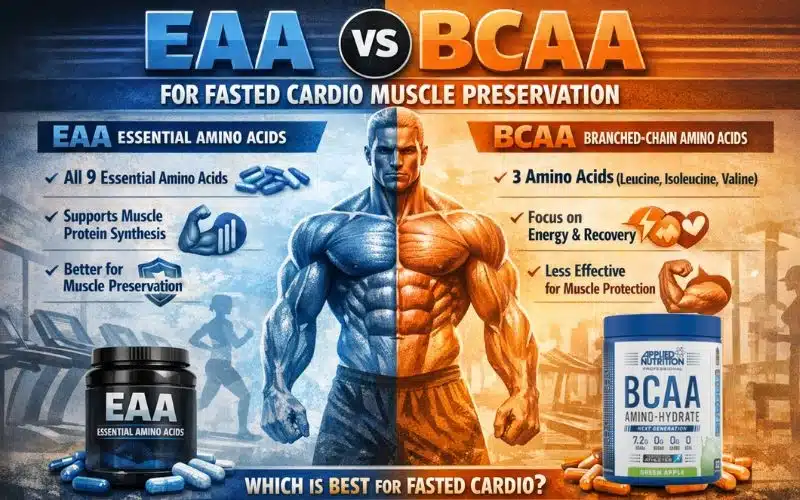
EAA vs BCAA for Fasted Cardio Muscle Preservation
Fast cardio has a loyal following among fat-loss enthusiasts, and for good reason , training on an empty stomach pushes the body to tap into stored fat as fuel. But there is a catch that most people overlook. Without circulating amino acids in the bloodstream, the body can just as easily break down muscle tissue to meet its energy demands.
What Actually Happens to Muscle During Fasted Training
During an overnight fast, glycogen stores drop and cortisol levels rise. Cortisol is a catabolic hormone, and in a fasted state, it signals the body to pull amino acids from muscle tissue through a process called gluconeogenesis , essentially converting protein into glucose for fuel.
- Muscle protein breakdown accelerates when fasting extends beyond 8 to 10 hours
- Cortisol peaks in the early morning, which is exactly when most people do fasted cardio
- The absence of dietary protein removes the anabolic signal needed to suppress this breakdown
- Even moderate-intensity cardio in a fasted state can elevate muscle protein breakdown rates significantly
This is not a theoretical concern. It is a real metabolic trade-off that affects how much lean mass someone retains over weeks and months of fasted training.

Defining the Two Supplements Clearly
EAAs, or Essential Amino Acids, are a group of nine amino acids the body cannot produce on its own: leucine, isoleucine, valine, lysine, methionine, phenylalanine, threonine, tryptophan, and histidine. All nine must come from diet or supplementation. BCAAs, or Branched-Chain Amino Acids, are a subset of three , leucine, isoleucine, and valine , named for their branched molecular structure. BCAAs are included within the EAA group, not separate from it.
The distinction matters enormously in the context of fasted cardio because muscle protein synthesis, the process that builds and preserves muscle, requires all nine essential amino acids working together.
Why BCAAs Alone Fall Short During Fasted Cardio
BCAAs became popular because leucine specifically acts as a direct trigger for mTOR, the signaling pathway that initiates muscle protein synthesis. That part is accurate. The problem is that triggering mTOR without providing the full amino acid pool needed to complete the synthesis process is like starting a car without fuel in the tank. The engine turns over but cannot drive anywhere.
Research consistently shows that BCAA supplementation alone does not produce a meaningful net anabolic response in a fasted state. The body still lacks the raw materials needed to build or fully preserve muscle tissue. So while BCAAs can reduce the perception of muscle soreness and provide a small anti-catabolic effect, they are fundamentally incomplete for the goal of true muscle preservation during fasted cardio.
The Case for EAAs During Fasted Training
EAAs deliver all nine essential amino acids, which means the body receives everything needed to complete muscle protein synthesis rather than just a portion of the signal. During fasted cardio, sipping on an EAA supplement before or during the session supplies the bloodstream with circulating amino acids that suppress muscle protein breakdown while simultaneously providing the substrate for repair and maintenance.
- Leucine content in EAAs still activates mTOR just as effectively as standalone BCAAs
- The presence of lysine, threonine, and methionine allows synthesis to actually complete
- Histidine contributes to carnosine production, which buffers lactic acid during cardio
- Tryptophan plays a role in serotonin regulation, supporting mood and endurance
For someone training fasted three to five mornings per week, the cumulative difference in muscle preservation between EAA and BCAA supplementation becomes measurable over a 6 to 12-week period.
Caloric Impact Matters for True Fasted Cardio
One argument in favour of BCAAs over EAAs is that BCAAs contain fewer calories , typically 20 to 30 calories per serving versus 30 to 50 for a full EAA profile. For strict intermittent fasting practitioners, even these small caloric loads are a concern.
The practical answer here is nuanced. Neither EAAs nor BCAAs will meaningfully disrupt fat oxidation at these caloric amounts, particularly when exercise is already taking place and metabolic demand is elevated. The insulin response from EAAs is modest and transient, and it does not override the fat-burning state to any significant degree during active exercise. The muscle preservation benefit of EAAs far outweighs the marginal caloric concern for most people.
Timing and Dosing for Maximum Preservation
Getting the timing right amplifies whatever supplement someone chooses. For fasted cardio specifically, the window before and during training is critical , not after.
- Take EAAs 10 to 15 minutes before starting fasted cardio for peak absorption timing
- Sip EAAs throughout longer sessions exceeding 45 minutes to maintain amino acid availability
- A dose of 8 to 12 grams of EAAs provides sufficient leucine and full-spectrum coverage
- Pair with water and electrolytes rather than carbohydrates to maintain the fasted environment
Comparing EAA and BCAA Directly for the Fasted Cardio Goal
Both supplements have merit, but they serve different purposes. A direct comparison for the specific goal of muscle preservation during fasted cardio makes the winner clear.
BCAAs remain a reasonable option for someone who does short, low-intensity fasted sessions of 20 to 30 minutes and already eats a high-protein diet. In that scenario, the incomplete amino acid profile matters less because the muscle-building environment is already supported by diet throughout the rest of the day. Fat burning cardio workouts at low intensity require less muscle repair signalling than high-intensity efforts.
EAAs are the clear choice when sessions extend beyond 30 to 45 minutes, when training intensity is moderate to high, when the overall protein intake across the day is sub-optimal, or when the person is in a significant caloric deficit. These are the conditions where having all nine essential amino acids available makes a tangible protective difference.
Practical Application for Different Training Styles
Not every fasted cardio session looks the same. A 25-minute low-intensity walk on the treadmill puts very different demands on muscle tissue compared to a 50-minute moderate-intensity cycling session or interval training. The supplement choice should reflect the actual training demand.
- Low intensity, short duration: BCAAs may be sufficient, though EAAs remain the safer option
- Moderate intensity, 30 to 60 minutes: EAAs provide meaningful preservation benefit
- High intensity or interval-based fasted cardio: EAAs are non-negotiable for muscle protection
- Strength training in a fasted state: Full muscle building support from EAAs plus post-workout protein is essential
The lower body strength exercises performed fasted, such as lunges and leg press, place particularly high catabolic stress on large muscle groups where amino acid availability is critical for recovery.

What About Post-Cardio Nutrition
EAA supplementation during fasted cardio is not a replacement for proper post-workout nutrition , it is a bridge. After completing the session, breaking the fast with a protein-rich meal or a quality whey protein shake within 30 to 60 minutes remains important for stimulating the full anabolic recovery response.
Some people stack EAAs pre-cardio with casein protein the night before to further reduce overnight muscle breakdown. Casein protein digests slowly and supplies amino acids through the overnight fast, which means the body arrives at the morning session with a slightly higher amino acid baseline. It is a strategy worth considering for those who prioritise muscle retention above all else.
The Verdict for Muscle Preservation During Fasted Cardio
When the goal is protecting hard-earned muscle during fasted training sessions, EAAs deliver a more complete solution than BCAAs alone. The science is not close , full-spectrum essential amino acids provide both the anabolic signal and the raw material needed for muscle protein synthesis, while BCAAs only provide the signal without the means to complete the process.
That said, any amino acid supplementation during fasted cardio is better than none at all. Someone switching from no supplementation to BCAAs will notice less muscle soreness and better recovery. Someone switching from BCAAs to EAAs will notice better muscle fullness, improved strength retention during cutting phases, and a more resilient physique over time.
For anyone serious about optimising body composition , losing fat while protecting or even building lean mass , EAAs before fasted cardio represent one of the highest-value, lowest-risk supplement choices available. Combined with a consistent training routine, strategic caloric intake, and proper post-workout nutrition, this single swap can meaningfully shift the outcome of a fat-loss phase in favour of the physique you are actually working toward.


About author

Related posts

Walk into any gym in Lahore, Karachi, or Islamabad before 6 p.m. and you’ll spot two camps: the ones sipping black coffee from a flask,... Continue reading

If you’ve stood in a supplement store or scrolled SportsOne’s shop wondering whether to buy BCAA, whey protein, or both, you’re not alone. It’s one... Continue reading

Ask a Pakistani woman why she avoids protein shakes. One fear comes up almost every time: “Won’t it make me look like a bodybuilder?” This... Continue reading

If you’ve ever stood in front of a supplement shelf and wondered, “Is whey protein halal?” you’re not alone. This question concerns many Pakistani gym-goers... Continue reading

Walking into a supplement store or browsing one online for the first time can feel overwhelming. Rows of tubs promise faster muscle growth, better recovery,... Continue reading
Add comment