
No products in the cart.
Return To Shop
Vitamin D Price in Pakistan 2026 Best Brands Compared
Last updated: 12 August 2026
Pakistan sits on some of the sunniest latitude on earth, yet vitamin D deficiency is reported in the overwhelming majority of adults tested in local studies. If you searched for the vitamin D price in Pakistan, you’ve probably already had a lab report come back with a number in the “deficient” or “insufficient” range and a doctor’s note to start supplementing. This guide breaks down what vitamin D3 actually costs in Pakistan in 2026, which doses matter, how to take it safely, and how to pick a brand that’s actually worth the money.
Why Is Vitamin D Deficiency So Common in Pakistan?
It sounds contradictory — a country with year-round sun producing a population that’s largely deficient — but the reasons are lifestyle-driven, not climate-driven:

- Indoor-heavy routines: Office jobs, school, and commuting in covered vehicles mean most skin never sees direct sun.
- Clothing coverage: Modest dress styles common across the country block the UVB exposure needed for skin synthesis.
- Pollution and haze: Urban smog in cities like Lahore and Karachi filters out a meaningful percentage of UVB rays even on clear-looking days.
- Low dietary intake: Vitamin D–rich foods (fatty fish, egg yolks, fortified dairy) aren’t dietary staples for most households.
- Darker skin tone: Higher melanin content requires longer sun exposure to produce the same amount of vitamin D as lighter skin.
The result is that even active, outdoor-working individuals can test deficient — which is why supplementation, not just “get more sun” advice, has become the standard fix recommended by doctors here.
Vitamin D Price in Pakistan 2026 — Brand Comparison Table
Prices below reflect standard retail pack sizes as of August 2026 and will vary slightly by city, pharmacy, and ongoing promotions.
| Brand | Strength / Pack | Price (PKR) | Best For |
| Route2Health Vitamin D3 | 5,000 IU | ~Rs. 750 | Budget daily maintenance dose |
| Local pharma brands (Bonex-D, Qalsan-D type) | 125–500 IU + calcium, 30–60 ct | Rs. 245 – 975 | Low-dose combined calcium support |
| Mid-range local/entry international | 1,000–5,000 IU, 60–90 ct | Rs. 1,150 – 2,300 | Confirmed mild-to-moderate deficiency |
| Nature’s Bounty D3 | 1,000 IU, 250 softgels | ~Rs. 4,295 – 4,995 | Long-term daily maintenance, low cost-per-day |
| Nature’s Bounty D3 | 5,000 IU, 150 softgels | ~Rs. 4,400 – 4,995 | Doctor-recommended standard therapeutic dose |
| Nature’s Bounty D3 | 10,000 IU, 72 softgels | ~Rs. 4,150 – 6,200 | Severe, lab-confirmed deficiency (under supervision) |
| Webber Naturals / NOW Foods D3 (+K2 variants) | 1,000–5,000 IU | Rs. 2,500 – 5,000 (varies by pack) | Bone health stacking with Vitamin K2 |
Note: Prices fluctuate with exchange rate shifts on imported brands and periodic pharmacy discounts. Always confirm current pricing before ordering.
Vitamin D Dosage, Timing & Safety — What Actually Matters
Most vitamin D advice online stops at “take one softgel a day,” which skips the two details that actually determine whether supplementation works: timing and dose progression. Vitamin D is fat-soluble, so it absorbs significantly better when taken with a meal that contains some fat — an egg, a spoon of ghee in your daaal, or a glass of milk — rather than on an empty stomach first thing in the morning. Taking it dry, on an empty stomach, is one of the most common reasons people retest after three months and see almost no improvement despite “taking it every day.”
Dose progression matters just as much as timing. A typical protocol used by practitioners in Pakistan for a confirmed moderate deficiency (25-OH vitamin D below roughly 20 ng/mL) is a higher loading dose — often a Nature’s Bounty D3 5,000 IU softgel (roughly Rs. 4,400–4,995 for a 150-count bottle, working out to under Rs. 35 per day) taken daily for 8–12 weeks, followed by a drop to a 1,000–2,000 IU maintenance dose once levels normalize. Jumping straight to a 10,000 IU product without a baseline test, or continuing a high loading dose indefinitely “just to be safe,” is where most self-dosing mistakes happen — vitamin D toxicity is rare, but it does occur with sustained high-dose use, and it typically shows up as elevated blood calcium rather than any early warning symptom you’d notice on your own.
A few safety notes worth flagging before you buy: vitamin D can interact with corticosteroids, some cholesterol-lowering medications, and certain diuretics, so mention it to your doctor if you’re on any of those. It’s also not a substitute for calcium if a bone-density scan has flagged low bone mass — the two work together, not interchangeably. And if you’re pregnant, breastfeeding, or supplementing a child, stick to the dose your doctor sets rather than an adult maintenance dose scaled down by guesswork.
How to Choose the Right Vitamin D Dose
The right strength depends entirely on your blood test result, not on what’s cheapest or most popular. As a general reference point used by practitioners in Pakistan:
- Maintenance (sufficient levels): 1,000–2,000 IU daily
- Mild-to-moderate deficiency: 5,000 IU daily or a weekly loading protocol, for a set period
- Severe deficiency: High-dose weekly or monthly protocols (often 50,000–200,000 IU), prescribed and monitored by a doctor
Self-dosing at high strengths without a baseline blood test is not advisable. Vitamin D is fat-soluble and accumulates in the body, so more is not automatically better.
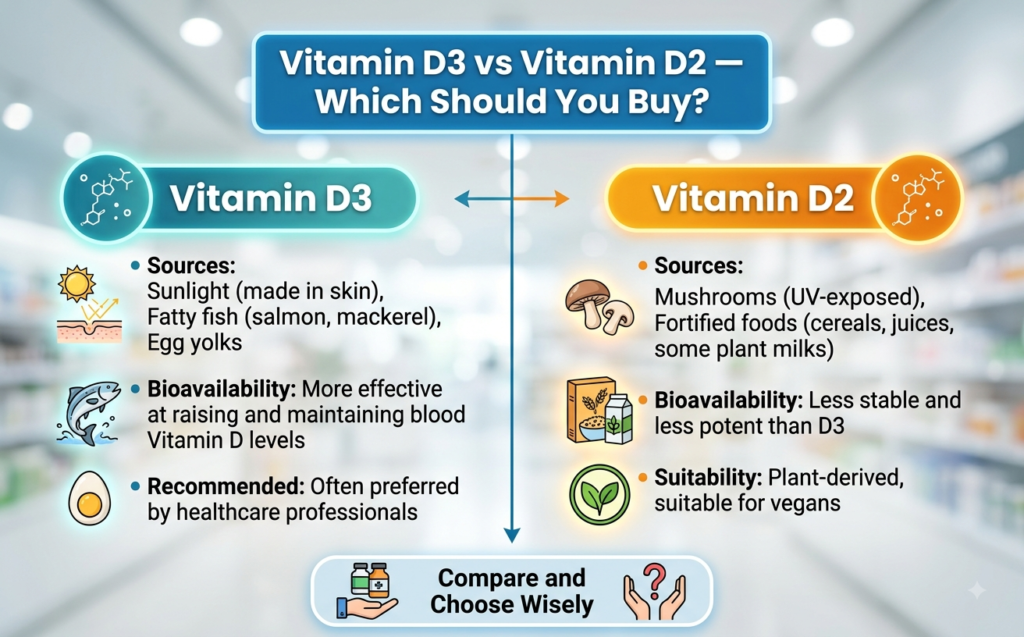
Vitamin D3 vs Vitamin D2 — Which Should You Buy?
Almost every product worth buying in Pakistan is labeled D3 (cholecalciferol) rather than D2 (ergocalciferol). D3 is the form your skin naturally produces from sunlight and is significantly more effective at raising and maintaining blood levels over time. If a label just says “Vitamin D” without specifying, check the ingredient panel — D3 should always be the default choice unless a doctor has specifically prescribed D2.
Checking Authenticity Before You Buy
Imported vitamin D brands are a common counterfeit target in Pakistan because the softgels themselves are hard to tell apart. Before ordering, check that the seller lists a batch/lot number and expiry date in the product photos, that the outer seal is intact on delivery, and that the retailer is an authorized importer rather than a reseller with no verifiable supply chain. If a price looks significantly below every other listing for the same brand and strength, treat that as a red flag rather than a deal.
Stacking Vitamin D With Other Vitamins & Minerals
Vitamin D works alongside several other nutrients your body needs for it to actually do its job:
- Calcium & Vitamin K2: K2 directs the calcium that vitamin D helps you absorb toward your bones instead of your arteries. Our calcium and vitamin D combination guide and Vitamin K2 supplements guide cover how the three fit together. If you’d rather start with a straightforward combined product, the Applied Nutrition Calcium Magnesium tablets are a practical pairing option.
- Vitamin C: Doesn’t interact directly with vitamin D, but is worth reviewing if you’re building a general immunity stack — see our Vitamin C price in Pakistan breakdown.
- Multivitamins: If you’re not sure whether a single-nutrient product or an all-in-one makes more sense for your routine, our do multivitamins actually work article walks through when each approach fits better.
If you’re already active or training regularly, it’s also worth looking at your broader vitamin supplements in Pakistan intake rather than just vitamin D in isolation. Many gym-goers running a hard training split are simultaneously low in D, magnesium, and zinc without realizing it, since all three get depleted through sweat and intense activity.
Related read: If your training schedule is heavy, our Omega 3 price in Pakistan guide is worth checking alongside your vitamin D — recovery nutrients tend to work best as a stack, not in isolation.
Signs You Might Be Vitamin D Deficient
- Persistent fatigue that doesn’t improve with sleep
- Bone or lower back pain
- Muscle weakness or frequent cramping
- Slow recovery from workouts or minor injuries
- Low mood, especially during winter months
- Frequent colds or infections
None of these are exclusive to vitamin D deficiency, so a blood test (25-hydroxy vitamin D) is the only reliable way to confirm it before you start supplementing at therapeutic doses. See our guide on signs of vitamin deficiency for the broader picture beyond just vitamin D.
Where to Buy Genuine Vitamin D in Pakistan
Sports One International stocks authentic, authorized-import vitamin D3 brands alongside a full range of vitamin supplements in Pakistan, with Cash on Delivery and WhatsApp ordering nationwide. If you’re building out a broader supplement routine rather than buying vitamin D on its own, that category page is the best starting point to compare D3, K2, calcium, and multivitamin options side by side.
Final Take
Vitamin D in Pakistan is inexpensive relative to how widespread the deficiency is. A full year of maintenance dosing from a reputable brand often costs less than a single restaurant dinner out. The mistake most buyers make isn’t overspending; it’s guessing their dose instead of testing first, taking it on an empty stomach where it barely absorbs, or buying whatever’s cheapest at the counter without checking the IU strength actually matches what they need. Get tested, take it with a fat-containing meal, match the dose to the result, and treat it as a long-term maintenance habit rather than a one-time fix.
Frequently Asked Questions
What is the average vitamin D price in Pakistan in 2026?
Prices range from roughly Rs. 750 for budget local brands up to Rs. 6,200 for high-dose international brands like Nature’s Bounty, depending on the vitamin D strength (IU), brand, formulation, and pack size. Premium imported supplements generally cost more than locally manufactured options.
Is 5000 IU vitamin D safe to take daily?
For most adults with a confirmed vitamin D deficiency, 5,000 IU daily is a commonly prescribed short-term therapeutic dose, typically for 8–12 weeks before dropping to a maintenance level. It should be based on a blood test and, ideally, taken under medical supervision rather than continued indefinitely.
What is the best time to take vitamin D for better absorption?
Vitamin D is fat-soluble, so it absorbs best when taken with a meal containing some fat, such as eggs, milk, or a meal cooked with ghee or oil. Taking it on an empty stomach first thing in the morning is a common reason people don’t see their blood levels improve.
Should I buy Vitamin D3 or Vitamin D2?
Vitamin D3 (cholecalciferol) is generally the preferred choice because it is more effective at increasing and maintaining blood vitamin D levels than Vitamin D2 (ergocalciferol). Unless your healthcare provider specifically recommends D2, most experts suggest choosing a quality Vitamin D3 supplement.
Can I take vitamin D with my protein or creatine supplements?
Yes. Vitamin D can be taken safely alongside protein powders, creatine, and other common sports nutrition supplements. There are no known harmful interactions, and many athletes include vitamin D as part of their daily supplement routine to support bone health, muscle function, and overall wellness.


About author

Related posts

For most healthy adults, collagen peptides are well tolerated. The side effects people actually report are mild: a feeling of fullness, bloating, an aftertaste or... Continue reading

The short answer: the best time to take collagen is whichever time you will repeat every single day. Research on hydrolysed collagen peptides has not... Continue reading
Neither is universally better. Marine collagen is often preferred for skin, hair and people who avoid beef, while bovine collagen is usually cheaper and offers... Continue reading

Collagen may help support joint comfort in some people, but the evidence is modest, results are slow, and it is not a substitute for medical... Continue reading
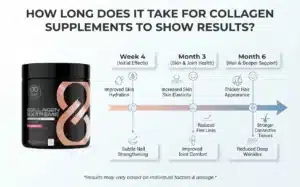
Most people notice their first change from collagen supplements after 4 to 8 weeks, with clearer skin and joint results building between 8 and 12... Continue reading
Add comment