
No products in the cart.
Return To Shop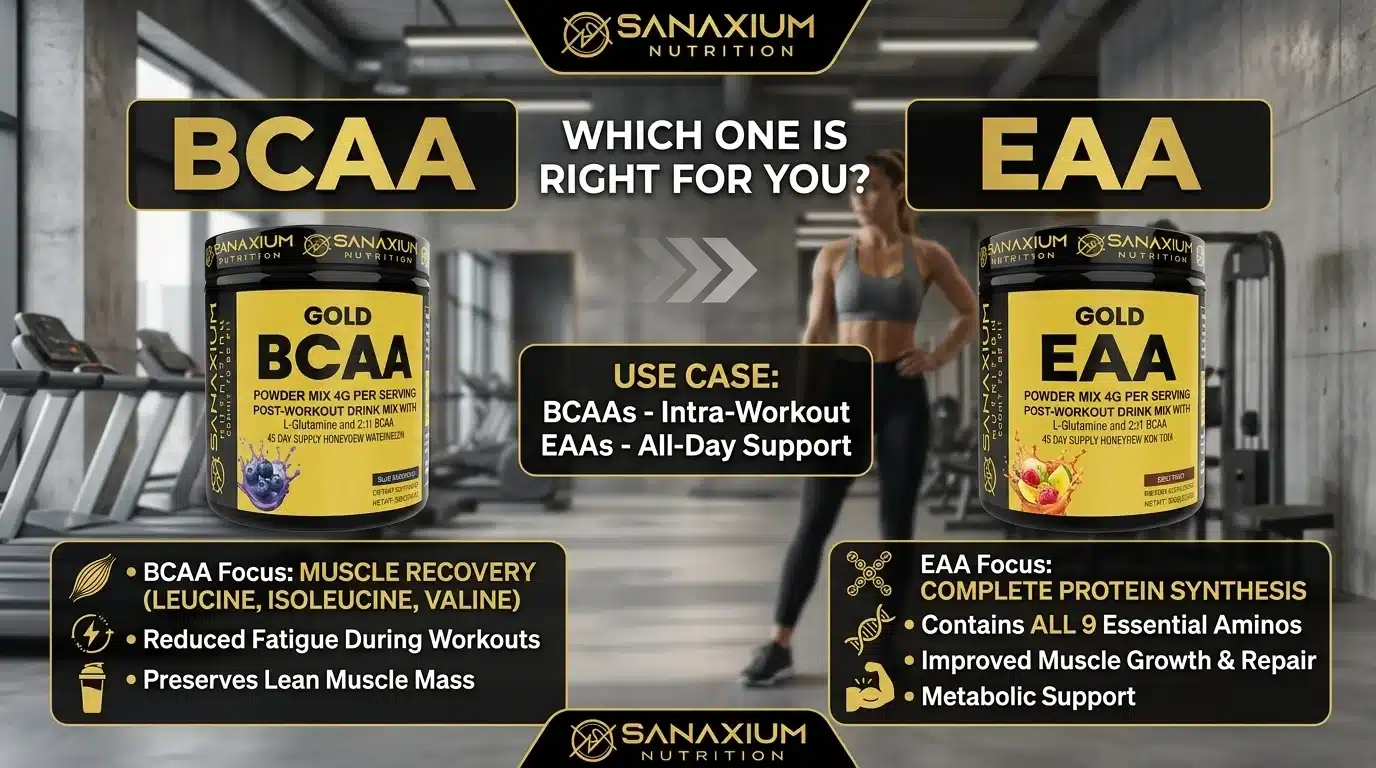
BCAA vs EAA: Which One Do You Actually Need?
If you have stood in front of a shelf of amino acid tubs wondering whether to buy BCAAs or EAAs, you are asking the right question. The honest answer to BCAA vs EAA is that for many lifters, neither is essential. For some situations, one of them is genuinely useful. This guide explains the difference, what the research supports, and who should spend money on which.
BCAAs are three of the nine essential amino acids. EAAs are all nine. If your protein intake is already high, you probably do not need either. If you train fasted, are cutting calories, or want a flavoured drink to sip through a long session, EAAs are the smarter choice for muscle, and BCAAs are the cheaper, lighter option.
The three BCAAs and the nine EAAs, briefly
Proteins are built from amino acids. Nine of them are called essential (EAAs) because your body cannot make them, so they must come from food or supplements: histidine, isoleucine, leucine, lysine, methionine, phenylalanine, threonine, tryptophan and valine.
Three of those nine, leucine, isoleucine and valine, have a branched molecular shape. These are the branched-chain amino acids (BCAAs). Leucine gets the most attention because it acts as the main “on switch” for muscle protein synthesis, the process your body uses to build and repair muscle.
So the relationship is simple. Every BCAA is an EAA, but a BCAA product contains only three of the nine. Want a deeper primer? Read our guide on what BCAAs are.

What the research actually supports
Here is where the marketing and the science part ways.
• BCAAs can start the process, not finish it. Leucine signals muscle to build. But to actually build new muscle tissue, your body needs all nine essential amino acids available. Taking BCAAs alone supplies the signal without the full set of raw materials.
• EAAs have stronger evidence for muscle protein synthesis. Studies comparing the two consistently show EAA mixtures stimulating muscle protein synthesis more completely than BCAAs alone.
• Soreness and fatigue benefits are modest. Some studies suggest BCAAs may slightly reduce perceived soreness after hard sessions. The effect is small and inconsistent, and it is not a substitute for sleep, calories and protein.
• Real-world results depend on your baseline diet. Most positive BCAA studies involve people eating little protein, training fasted, or in a calorie deficit. That context matters.
This is why EAA vs BCAA for muscle growth usually favours EAAs on paper, and why BCAA benefits are real but narrower than supplement labels suggest.
Why BCAAs do little if your protein intake is already high
This is the part many brands skip. If you eat enough protein, you are already getting BCAAs, and plenty of them.
Whey protein, eggs, chicken, fish, beef, paneer and dairy are all rich in leucine, isoleucine and valine. A single scoop of whey or a chicken breast can supply several grams of BCAAs, along with the other six essential amino acids that a BCAA tub leaves out. You can see the full picture in our amino acid profile of ISO whey.
A simple rule of thumb: if you are eating roughly 1.6 to 2.2 grams of protein per kilogram of bodyweight per day, spread across meals, adding BCAAs on top is unlikely to change your results. Your money is better spent on a quality protein, creatine, or simply more food.
So, do I need BCAA? If your diet is protein-rich, the honest answer is no.
When BCAAs or EAAs do make sense
There are a few situations where an amino supplement earns its place.
Fasted training. If you train first thing in the morning without eating, your body has no incoming protein. A serving of EAAs (or BCAAs) beforehand can help limit muscle breakdown without breaking your fast with a full meal. Our post on EAA vs BCAA for fasted cardio and muscle preservation goes deeper.
Cutting. When calories and often protein are lower, preserving muscle becomes the priority. EAAs can help top up amino acids with very few calories.
Hot weather and long sessions. In Pakistani summers, sweat losses are high and appetite for heavy food drops. A flavoured amino drink with electrolytes helps you keep drinking, which supports performance in itself.
Low-protein or vegetarian diets. If hitting your protein target is hard, EAAs can help fill gaps, though improving your food and adding a protein powder is usually the better first step.
Which one in these cases? If budget allows, choose EAAs because they cover all nine essentials. If you mainly want a light, tasty intra-workout drink, BCAA formulas are a perfectly reasonable and cheaper option.
Intra-workout hydration formulas as the practical use case
Honestly, this is where most people get real value from a BCAA product. Many modern BCAA tubs are really intra-workout hydration drinks: amino acids plus electrolytes, sometimes with a little citrulline or other additions, in a flavour you actually want to drink.
The benefit is practical rather than magical. You drink more water during training, you replace some sodium and other electrolytes, and you enjoy the session more. That is a legitimate reason to buy one, and a better reason than expecting extra muscle.
If you are choosing between amino products and other staples, our comparison of BCAA vs creatine shows why creatine usually comes first on the priority list.

What we stock and what each is for
Browse our full BCAA category for current stock. Here is how the main options fit different needs. Prices change with imports and exchange rates, so check the live BCAA price in Pakistan on each product page.
| Product | Type | Best for |
| Scivation Xtend BCAA (30 servings) | BCAA intra-workout drink with electrolytes | Flavoured sipping during training, hot weather |
| Applied Nutrition BCAA Amino Hydrate (450g) | BCAA plus hydration formula | Long sessions, hydration-focused users |
| Elev BCAA Gold (300g) | BCAA powder | Budget-conscious intra-workout use |
| Sanaxium Nutrition Gold BCAA (300g) | BCAA powder | Budget-conscious intra-workout use |
| Elev BCAA Pro (90 capsules) | BCAA capsules | No-flavour, no-mixing convenience |
| Elev Essential Aminos (300g) | EAA powder | Fasted training, cutting, fuller amino coverage |
Wondering about the best BCAA in Pakistan? There is no single winner. For flavour and hydration, Xtend and Amino Hydrate are the popular picks. For value, the powders in the table work. For muscle-focused use, choose the EAA. Always check the label for the actual grams of leucine, isoleucine and valine per serving, and compare cost per serving, not tub price. Buying from a trusted seller also matters, so read our guide to checking imported supplement authenticity.
For more on choosing, see our best amino acid supplement guide for Pakistan.
Dosage and timing
Follow the label first, but these ranges are a sensible guide for healthy adults:
• BCAAs: about 5 to 10 grams per serving, with leucine making up the largest share.
• EAAs: about 10 to 15 grams per serving.
• Timing: sip before or during training. For fasted sessions, take it 15 to 30 minutes before you start.
• Frequency: once on training days is plenty. Skip it when your meals and protein shake already cover your target.
More detail in our guides on when to take amino acid supplements and how to use amino acid supplements. If you have a medical condition, are pregnant, or take medication, speak to your doctor first.
The bottom line
• Eating plenty of protein? Skip both and spend on protein or creatine.
• Training fasted or cutting? Choose EAAs.
• Want a tasty, hydrating intra-workout drink? A BCAA formula such as Xtend or Amino Hydrate does the job.
If you are still unsure, message our team and we will help you pick based on your diet, goals and budget.
FAQ
What is the difference between BCAA and EAA?
A BCAA supplement gives you three of the nine essential amino acids, while an EAA supplement gives you all nine. If your daily protein is high, you probably need neither. Both help most during fasted training, cutting, or long sessions.
Are EAAs better than BCAAs for muscle growth?
Research on muscle protein synthesis favours EAAs, because muscle needs all nine essential amino acids to build new tissue. BCAAs trigger the signal but cannot supply the missing building blocks, so EAAs are the better pick for muscle growth overall.
Do I need BCAA if I take whey protein?
Most lifters eating enough protein do not need BCAAs. Whey, eggs, chicken and dairy already supply plenty of leucine, isoleucine and valine. BCAAs earn a place only when protein is low, training is fasted, or you want a flavoured drink.
What is the BCAA price in Pakistan?
BCAA prices in Pakistan vary by brand, size and servings, so compare cost per serving rather than tub price. Check the live price on each SportsOne product page, because import costs and stock levels can change often during the year.
How much BCAA or EAA should I take and when?
Take 5 to 10 grams of BCAAs, or 10 to 15 grams of EAAs, sipped before or during training. Skip them on days when meals and a whey shake already hit your protein target, since extra amino acids add little.

About author

Related posts

For most healthy adults, collagen peptides are well tolerated. The side effects people actually report are mild: a feeling of fullness, bloating, an aftertaste or... Continue reading

The short answer: the best time to take collagen is whichever time you will repeat every single day. Research on hydrolysed collagen peptides has not... Continue reading
Neither is universally better. Marine collagen is often preferred for skin, hair and people who avoid beef, while bovine collagen is usually cheaper and offers... Continue reading
Collagen may help support joint comfort in some people, but the evidence is modest, results are slow, and it is not a substitute for medical... Continue reading
Most people notice their first change from collagen supplements after 4 to 8 weeks, with clearer skin and joint results building between 8 and 12... Continue reading
Add comment