
No products in the cart.
Return To Shop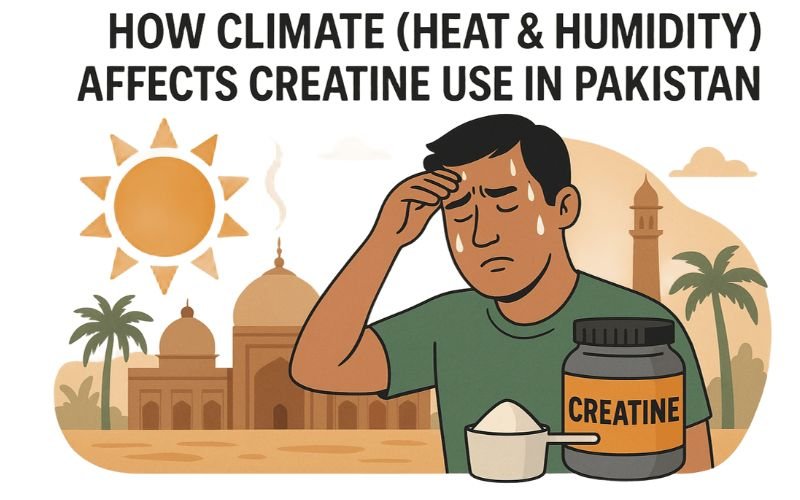
How Climate (Heat & Humidity) Affects Creatine Use in Pakistan
Last updated: September 2026
Creatine is one of the most researched and effective sports supplements in the world. But in a country like Pakistan, where summer temperatures regularly cross 40°C and coastal humidity climbs past 70%, gym-goers keep asking the same question: does the climate actually change how creatine works?
No — heat and humidity don’t change how creatine works once it’s in your body. What they do change is how much water and electrolytes you lose through sweat, and how well the powder itself holds up if it’s left in a hot car or a humid gym bag. Manage hydration and storage, and creatine performs exactly the way the research says it should — even in a Lahore or Karachi summer.
Understanding Creatine and Its Role in Muscle Function
Creatine is a naturally occurring compound stored mostly in skeletal muscle as phosphocreatine. It helps regenerate ATP (adenosine triphosphate), the body’s primary energy currency during short, high-intensity efforts like sprinting or heavy leg training. None of that chemistry changes because the room is hot — creatine’s job happens inside the muscle cell, not in the ambient air.

Common Forms of Creatine Sold in Pakistan
- Creatine Monohydrate — the most researched and affordable form, and the one nearly every clinical dosing guideline is built around
- Micronized Creatine Monohydrate — the same molecule, ground into finer particles so it dissolves faster and resists the clumping that humid storage can cause
- Creatine Ethyl Ester and other blended forms — less researched, and not something we’d prioritize over monohydrate for hot-climate use
Creatine Monohydrate remains the default recommendation for Pakistani athletes — it’s the form almost every study on heat and hydration below is actually testing.
Pakistan’s Climate: A Real Challenge, Just Not the One Most People Think
Heat and Humidity Overview
From May to August, cities like Lahore, Multan, and Karachi regularly see:
- Daytime temperatures above 40°C (104°F)
- Humidity levels exceeding 70% in coastal areas like Karachi
These conditions increase sweat rate, which affects hydration and electrolyte balance — the two things that actually determine how well creatine (or any supplement) performs, not the ambient temperature itself.

What the Research Actually Says About Creatine, Heat and Dehydration
This is the part most “creatine in summer” articles skip. The International Society of Sports Nutrition’s 2017 position stand on creatine safety (Kreider et al.) reviewed decades of research and found no credible evidence that creatine supplementation increases the risk of dehydration, cramping, or heat illness in healthy adults — even those training in hot, humid environments. That old warning about creatine “pulling water away from the rest of the body” doesn’t hold up: creatine draws water into muscle cells (intracellular hydration), and multiple controlled studies have shown total body water stays stable or even improves with supplementation, rather than dropping. Some researchers argue the opposite of the popular myth may be closer to true — by increasing intracellular fluid, creatine may support thermoregulation rather than working against it.
Where the science does leave a choice is dosing strategy. The ISSN protocol allows for either a short loading phase (roughly 20g/day, split into four 5g doses, for 5–7 days) followed by a 3–5g/day maintenance dose, or skipping loading entirely and taking 3–5g/day from day one — reaching the same full muscle saturation in about three to four weeks. For lifters training through a Pakistani summer, the no-load approach is usually the more comfortable option: it avoids the extra fluid shift of a loading phase during the exact weeks your body is already managing more sweat loss than usual.
For a practical starting point, a product like ON (Optimum Nutrition) Micronized Creatine Powder, 300g (around [INSERT CURRENT PRICE] on SportsOne) works well for hot-climate use for two practical reasons beyond the dosing itself: it’s unflavored, so it mixes cleanly into whatever volume of water you’re already drinking to rehydrate, and the micronized particle size resists the clumping that humidity causes in standard monohydrate. Whichever brand you choose, the safety principle stays the same — 3–5g of monohydrate daily, taken consistently, with total daily fluid intake adjusted upward to match sweat loss, not because creatine itself demands more water.
Where Heat & Humidity Genuinely Do Matter
1. You’re Losing More Fluid, Not Because of Creatine
You’re already sweating more in Pakistan’s heat regardless of supplementation. Skip proper fluid intake and you risk dehydration, cramps, and fatigue — creatine or not.
Pro tip: Increase your daily water intake by 1–2 liters during peak summer months if you’re supplementing with creatine and training outdoors or in an un-cooled gym.
2. Sweat and Electrolyte Loss
Heavy sweating depletes sodium and potassium, which can leave you feeling flat in the gym regardless of what’s in your shaker. An electrolyte supplement alongside your water intake helps close that gap faster than water alone.
3. Storage Is the Real Product-Level Risk
Creatine monohydrate is hygroscopic — it absorbs ambient moisture. Left in a hot car, a gym locker, or a humid kitchen shelf, the powder can clump or degrade in quality over time. This is a storage issue, not a biochemical one. Keep your tub in:
- A cool, dry cupboard — not the car, not near a window
- A tightly sealed container after every scoop
Hydration Tips for Creatine Users in Pakistan
- Drink 3–4 liters of water daily while using creatine through summer
- Add an electrolyte tablet or ORS sachet on heavy-training or outdoor days
- Monitor urine color as a rough hydration gauge — pale yellow is the target
Best Creatine Options for Hot, Humid Storage Conditions

Any creatine monohydrate works the same way biochemically — the differences below come down to particle size, packaging, and mix quality, which matter more once humidity is in the picture.
| Brand & Product | Form | Serving Size | Price | Why It Suits Pakistan’s Climate |
|---|---|---|---|---|
| ON Micronized Creatine, 300g | Micronized monohydrate | 5g / ~60 servings | [INSERT CURRENT PRICE] | Fine micronized particles resist humidity clumping; unflavored for easy mixing into extra fluids |
| MuscleTech Platinum Creatine, 400g | Standard monohydrate | 5g / ~80 servings | [INSERT CURRENT PRICE] | Larger tub keeps cost-per-serving low for daily maintenance dosing through the whole summer |
| Cellucor COR-Performance Creatine, 306g | Standard monohydrate | 5g / ~60 servings | [INSERT CURRENT PRICE] | Wide-mouth, resealable tub that’s easier to keep airtight between scoops |
See the full lineup in our best creatine brands in Pakistan guide, or compare current pricing across SKUs in our creatine price guide.
Best Practices for Using Creatine During Pakistani Summers
💊 Dosage
- 3–5g per day — no loading phase required, and generally the more comfortable choice in peak heat
- Take it consistently — creatine works on saturation over weeks, not on a single hot-day dose
🕒 Timing
- Post-workout is a fine default, though research shows the timing window matters less than daily consistency
- Avoid pre-workout stacks that combine creatine with high-dose stimulants on extremely hot training days, since the stimulant load — not the creatine — is what raises core temperature and heart rate
If you’re also managing training volume through summer, our guides on creatine for cutting vs. bulking and who should avoid creatine cover scenarios this article doesn’t.
Frequently Asked Questions
Does hot weather make creatine less effective?
No. Creatine works the same way inside muscle tissue regardless of outside temperature. What changes in hot weather is your fluid and electrolyte needs, not creatine’s mechanism of action.
Can I take creatine during Pakistan’s peak summer heat?
Yes. Research shows no increased dehydration or heat-illness risk from creatine in healthy adults. Stick to 3–5g daily, drink extra water to match sweat loss, and train indoors during 12–4 PM peak heat where possible.
Does creatine cause dehydration or heatstroke in humid weather?
Not directly, and current research contradicts the old myth. Heatstroke risk in Pakistan’s summer comes from inadequate fluids and overtraining in extreme heat, not from creatine itself.
How should I store creatine powder in Pakistan’s climate?
Keep it in a sealed, airtight container in a cool, dry cupboard. Creatine is hygroscopic and absorbs moisture, so avoid leaving it in a hot car, gym bag, or humid kitchen shelf where it can clump.
Should I change my creatine dosage in extreme heat?
Not the creatine dose itself — 3–5g daily still applies. What should change is your total water intake, increased by roughly 1–2 liters a day to offset extra sweat loss during peak summer training.
Conclusion: Use Creatine Smartly in Pakistan’s Climate
Creatine is a powerful, well-studied tool for building muscle and improving performance — and the research is clear that Pakistan’s heat and humidity don’t change that. The real variables you control are hydration, electrolyte intake, and how you store the powder itself.
Get your supplements from a source you can verify. SportsOne has been an authorized international distributor of imported supplement brands since 2002, with store locations in Karachi, Lahore, Islamabad, and Gujranwala, plus Cash on Delivery and WhatsApp ordering nationwide — so what’s in the tub matches what’s on the label, no matter how hot the season gets. Browse our full range of Imported Supplements in Pakistan, or shop heat-tested creatine directly.


About author

Related posts

For most healthy adults, collagen peptides are well tolerated. The side effects people actually report are mild: a feeling of fullness, bloating, an aftertaste or... Continue reading

The short answer: the best time to take collagen is whichever time you will repeat every single day. Research on hydrolysed collagen peptides has not... Continue reading
Neither is universally better. Marine collagen is often preferred for skin, hair and people who avoid beef, while bovine collagen is usually cheaper and offers... Continue reading

Collagen may help support joint comfort in some people, but the evidence is modest, results are slow, and it is not a substitute for medical... Continue reading

Most people notice their first change from collagen supplements after 4 to 8 weeks, with clearer skin and joint results building between 8 and 12... Continue reading
Add comment