
No products in the cart.
Return To Shop
How Much Does Creatine Cost in Pakistan? Price Factors, Sizes & Buying Guide
Last Updated: 24 September 2026
Two tubs of creatine can sit side by side on a shelf with a Rs. 5,000 gap between them, and the cheaper one is not automatically the better deal. The sticker price tells you very little on its own. What actually matters is how many grams you get, how many days those grams last, where the product came from and whether it is genuine.
This guide explains how much creatine costs in Pakistan, why prices differ between brands and tub sizes, and how to work out real value using price per gram and price per serving. If you already know what you want and just need today’s rates, head straight to our creatine range.

How Much Does Creatine Cost in Pakistan? The Short Answer
As a rough guide, imported creatine monohydrate in the common 250g to 300g sizes sits at around Rs. 6,500 to Rs. 7,600 at authorised retailers. Premium micronized or patented-source products in 300g to 400g tubs run from about Rs. 10,900 to Rs. 12,800.
At a standard 5g daily dose, that works out to roughly Rs. 110 to Rs. 180 per day, or about Rs. 3,300 to Rs. 5,500 a month. Prices move with the exchange rate and stock levels, so use these ranges as a starting point rather than a quote.
| Tier | Typical tub size | Typical price range | Approx. cost per 5g serving |
| Mainstream imported monohydrate (plain or flavoured) | 250g to 300g | Rs. 6,500 to Rs. 7,600 | Rs. 108 to Rs. 152 |
| Premium micronized or patented-source monohydrate | 300g to 400g | Rs. 10,900 to Rs. 12,800 | Rs. 160 to Rs. 182 |
Indicative ranges only. For brand-by-brand prices, see our creatine collection.
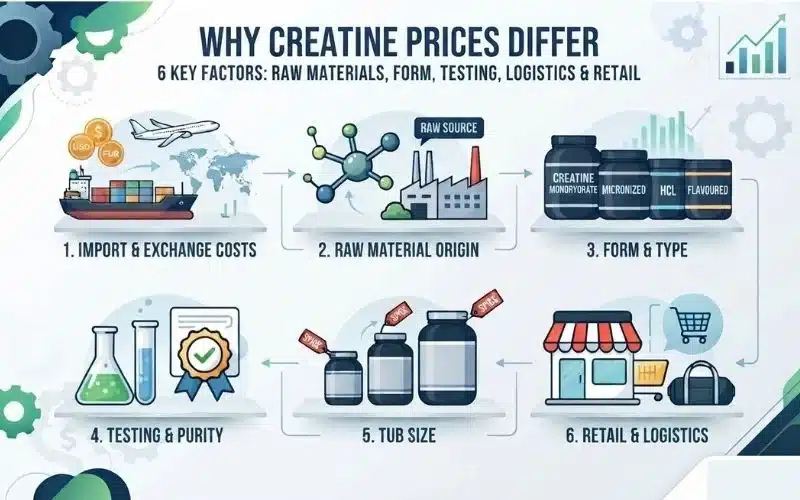
Why Creatine Prices Differ: 6 Price Factors
Almost every creatine tub on a Pakistani shelf contains the same basic compound. The price gap comes from everything around it.
1. Exchange rate and import costs
Most creatine sold in Pakistan is imported from the USA, UK and Europe. The retail price carries the USD/PKR exchange rate, import duties, freight and customs clearance. When the rupee weakens, shelf prices follow, usually with a lag of a few weeks as older stock sells through.
2. Raw material source
Some brands use Creapure®, a patented German creatine monohydrate made to a published purity specification. It costs manufacturers more than generic monohydrate, and that shows up in the retail price. Do not assume a brand uses it: sourcing can vary by market, so look for the Creapure® logo on the actual tub you are buying.
3. Form: monohydrate, micronized, HCL or flavoured
Plain creatine monohydrate powder is the cheapest form per gram. Micronized creatine is the same compound milled into finer particles so it mixes more easily, which adds a processing step. Creatine HCL costs more per gram but is taken in smaller daily amounts, so it has to be compared on cost per day instead (more on that below). Flavoured versions add sweeteners and flavouring, which usually adds a little to the price and reduces the grams of creatine per scoop.
Not sure which form suits you? Our guide to the best creatine for cutting vs bulking compares monohydrate and HCL in detail.
4. Testing and certification
Products made in GMP-certified facilities, tested by third parties or carrying Halal certification cost more to produce and verify. For most buyers these are worth paying for, because they are the only independent evidence that the label matches what is in the tub.
5. Tub size
Larger tubs usually cost less per gram because packaging and shipping are spread across more product. That saving only counts if you finish the tub while it is still fresh, which is covered in the next section.
6. Where you buy it
The same product can be priced differently across authorised retailers, general marketplaces and informal sellers. A lower price from an unverified seller often reflects grey-market sourcing, poor storage, short expiry or a counterfeit product, not a genuine discount.
150g vs 300g vs 500g: Which Creatine Size Gives Better Value?
At the standard maintenance dose of 5g a day, tub size translates directly into days of use:
| Tub size | Days at 5g/day | Best suited to |
| 150g | About 30 days | Trying creatine for the first time or testing a new brand |
| 250g | About 50 days | Short training blocks, checking how a flavour or form suits you |
| 300g | About 60 days | Most regular gym users; the easiest size to compare across brands |
| 400g | About 80 days | Consistent users who want fewer reorders |
| 500g | About 100 days | Long-term users who store supplements well |
The 150g trap if you plan to load
A loading phase usually means around 20g a day for 5 to 7 days, which uses 100g to 140g in the first week alone. If you plan to load, a 150g tub will be nearly empty within days, and you will pay the higher small-tub price per gram on your next order too. Loading is optional; our guide to using creatine powder explains both approaches.
Creatine 300g price: the market benchmark
300g is the most widely stocked creatine size in Pakistan, so it is the fairest size to compare brands on. Mainstream imported 300g tubs generally sit in the Rs. 6,500 to Rs. 7,500 range, while premium micronized 300g products cost noticeably more. If two 300g tubs differ by several thousand rupees, check the form, the raw material source and the seller before assuming one is overpriced.
Creatine 500g price: cheaper per gram, with conditions
A 500g tub typically offers a lower price per gram than a 300g tub of the same product, but 100 days is a long time for an opened tub in Pakistani heat and humidity. Moisture can make creatine clump and speeds up its breakdown. If you buy large, keep the lid sealed tight, store it away from the kitchen and bathroom, and read our guide on how heat and humidity affect creatine.
How to Calculate Creatine Price Per Serving and Per Gram
Three simple sums tell you more than any sticker price:
- Price per gram = tub price ÷ grams in the tub
- Price per serving = price per gram × your daily dose (usually 5g)
- Cost per month = price per gram × 150 (30 days at 5g)
Worked example
Here is how three typical tubs compare once you run the numbers:
| Tub A | Tub B | Tub C | |
| Size | 300g | 250g | 400g |
| Shelf price | Rs. 7,500 | Rs. 7,200 | Rs. 12,800 |
| Price per gram | Rs. 25.0 | Rs. 28.8 | Rs. 32.0 |
| Price per 5g serving | Rs. 125 | Rs. 144 | Rs. 160 |
| Cost per month | Rs. 3,750 | Rs. 4,320 | Rs. 4,800 |
Illustrative figures to show the method. Check live prices on the creatine category page.
Tub B looks cheaper than Tub A on the shelf, yet it costs more per gram. Tub C is the most expensive per gram, which may be perfectly reasonable if it uses a premium raw material or micronized form you specifically want. The point is to know what the extra rupees are buying.
Watch the serving size on the label
Brands do not all use the same scoop. One label might list 5g servings, another 3g, which makes the second tub appear to hold far more servings for the same weight. Always divide by grams, not by the servings number printed on the tub, and compare every product at the same daily dose.
Comparing creatine HCL fairly
Creatine HCL is usually taken at a smaller daily dose than monohydrate, so its higher price per gram does not tell the whole story. Compare HCL and monohydrate on cost per day at each product’s recommended dose. In most cases monohydrate still comes out cheaper, but the gap is smaller than the per-gram price suggests.
Imported, Local and Grey-Market Creatine: What the Price Gap Means
When one seller is much cheaper than everyone else, the product usually falls into one of these groups:
- Authorised imports: brought in through an official importer, carrying a local importer label, stored in controlled conditions and traceable by batch. This is the benchmark price.
- Grey-market imports: genuine products brought in through unofficial channels, often in personal luggage or small consignments. They can be real, but there is no local importer label, storage history is unknown and stock is sometimes close to expiry. There is also no one to go back to if something is wrong.
- Loose or repacked creatine: generic powder sold in unbranded bags or relabelled tubs. It is cheap, but there is no way to verify purity or quantity.
- Counterfeits: refilled or fake tubs made to look like well-known brands. These are priced just low enough to feel like a bargain.
If you are trying to spend less, a genuine budget brand from an authorised seller is almost always a better choice than a discounted “premium” tub from an unknown source.
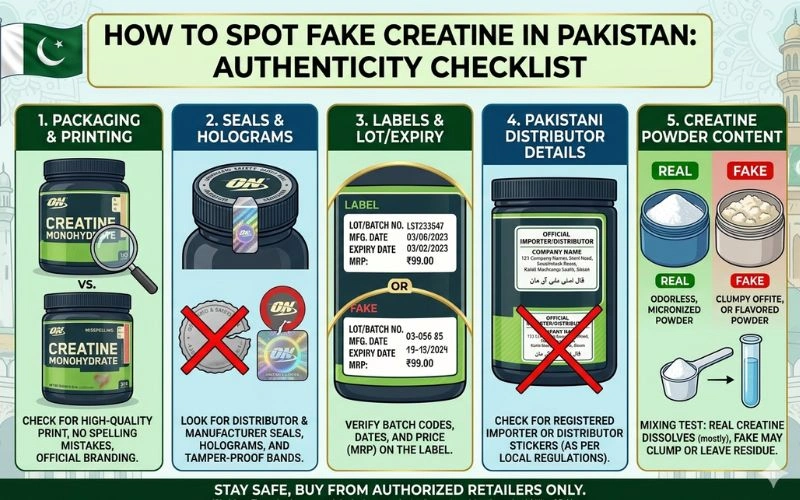
How to Spot Fake Creatine Before You Pay
- The price is far below what authorised retailers charge for the same tub
- The inner seal is missing, loose or looks re-glued
- There is no local importer label, or it looks printed at home
- Batch number and expiry date are stickered over, smudged or missing
- Printing, fonts or colours differ from the brand’s official packaging
- The label claims Creapure® but the logo is absent
- The powder is clumped, discoloured or smells unusual when first opened
For a fuller checklist with packaging examples, read how to buy original creatine in Pakistan online and our guide to spotting counterfeit imported supplements.
Does Halal Certification Change the Price?
Only slightly, if at all. Modern creatine monohydrate is made synthetically without animal-derived ingredients, and many imported brands already carry Halal certification or use a Halal-certified raw material, so certified options exist across most price tiers. If certification matters to you, check the label rather than paying extra on assumption. Our Halal creatine guide for Pakistan covers this in more depth.
How to Compare Creatine Prices: A 5-Step Value Check
- Decide on the form. Plain or micronized monohydrate suits most people. Choose HCL or flavoured only if you have a specific reason.
- Work out price per gram. Ignore the servings figure on the label and divide the price by the grams.
- Convert to cost per month. Multiply price per gram by 150 to see what creatine really costs you at 5g a day.
- Match size to usage. Pick a tub you will finish in two to three months, especially in summer.
- Confirm the source. Buy from an authorised retailer and check the seal, importer label and batch details on delivery.
Once you have a shortlist, our best creatine brands in Pakistan guide compares the leading products on quality and features.
Buying Creatine From SportsOne
SportsOne International has been an authorised importer and distributor of sports nutrition in Pakistan since 2002. Every tub we sell comes through official channels with a traceable batch, and our range includes Halal-certified options at every budget.
- Nationwide delivery with Cash on Delivery
- Order or ask questions on WhatsApp
- Visit us in Karachi, Lahore, Islamabad or Gujranwala
FAQs About Creatine Price in Pakistan
How much does creatine cost in Pakistan?
Mainstream imported creatine monohydrate in 250g to 300g tubs typically costs around Rs. 6,500 to Rs. 7,600 at authorised retailers. Premium micronized or patented-source products in 300g to 400g tubs cost roughly Rs. 10,900 to Rs. 12,800. At 5g a day, that is about Rs. 3,300 to Rs. 5,500 a month.
What is the creatine 300g price in Pakistan?
Most mainstream imported 300g creatine monohydrate tubs sit in the Rs. 6,500 to Rs. 7,500 range, while premium micronized 300g products cost noticeably more. A 300g tub lasts about 60 days at 5g a day.
Is a 500g tub of creatine better value than 300g?
Usually yes on price per gram, but only if you finish it while it is fresh. A 500g tub lasts about 100 days at 5g a day, so store it sealed in a cool, dry place, especially during Pakistani summers.
How do I calculate creatine price per serving?
Divide the tub price by the grams in the tub to get price per gram, then multiply by your daily dose, usually 5g. For example, a 300g tub at Rs. 7,500 costs Rs. 25 per gram, or Rs. 125 per 5g serving.
Why is creatine HCL more expensive than monohydrate?
Creatine HCL costs more to produce and is sold in smaller volumes. Because it is taken at a lower daily dose, compare it with monohydrate on cost per day rather than cost per gram. Monohydrate is usually still the cheaper option.
Why is creatine much cheaper on some online marketplaces?
Unusually low prices often point to grey-market stock, poor storage, short expiry dates or counterfeit products. Check for an intact seal, a local importer label and clear batch and expiry details, and buy from an authorised retailer where possible.
How long does a 300g creatine tub last?
About 60 days at the standard 5g daily dose. If you do a loading phase of around 20g a day for the first week, it will last roughly five to six weeks instead.
Is Creapure® creatine worth the extra cost?
Creapure® is a patented German creatine monohydrate made to a published purity specification. It works the same way as other monohydrate, so the extra cost buys quality assurance rather than extra results. It is worth it if verified purity matters to you.


About author

Related posts

For most healthy adults, collagen peptides are well tolerated. The side effects people actually report are mild: a feeling of fullness, bloating, an aftertaste or... Continue reading

The short answer: the best time to take collagen is whichever time you will repeat every single day. Research on hydrolysed collagen peptides has not... Continue reading
Neither is universally better. Marine collagen is often preferred for skin, hair and people who avoid beef, while bovine collagen is usually cheaper and offers... Continue reading

Collagen may help support joint comfort in some people, but the evidence is modest, results are slow, and it is not a substitute for medical... Continue reading
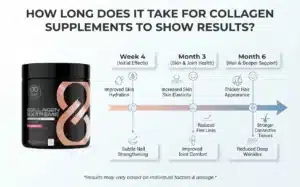
Most people notice their first change from collagen supplements after 4 to 8 weeks, with clearer skin and joint results building between 8 and 12... Continue reading
Add comment