
No products in the cart.
Return To Shop
Creatine Monohydrate Benefits: What It Actually Does for Muscle Growth
Ask ten gym-goers what creatine does and you’ll get ten different answers, most of them half right. Creatine monohydrate benefits go well beyond “it helps you lift more,” though that part is true too. It is one of the most heavily researched supplements in sports nutrition, and the science behind it is far more specific than most marketing copy lets on. This guide breaks down what creatine actually does in the body, how it drives muscle growth, and how to use it correctly if you’re training in Pakistan’s climate and buying through creatine in Pakistan options that are actually authentic.
What Does Creatine Do in the Body?
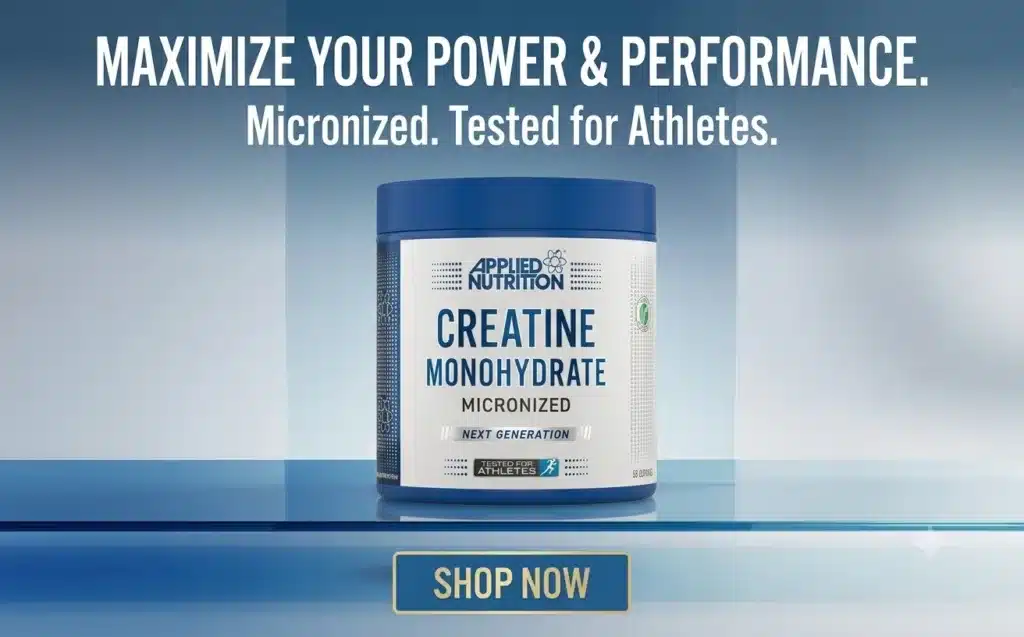
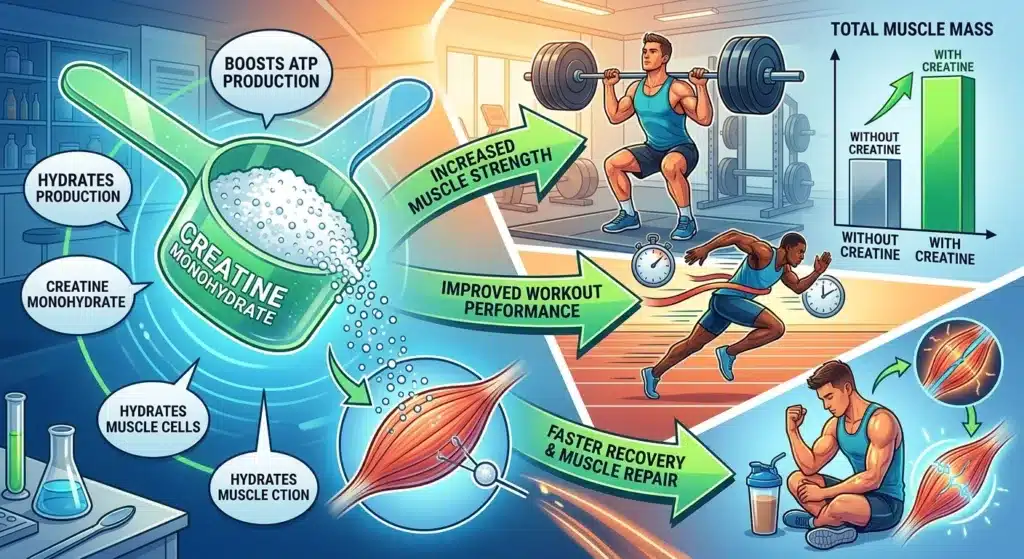
To understand what creatine do, you have to start with energy, not muscle. Creatine is a naturally occurring compound stored mostly in skeletal muscle, where it combines with phosphate to form phosphocreatine. During short, high-intensity effort, phosphocreatine donates that phosphate group to rapidly regenerate ATP, the molecule your cells burn for energy. More stored phosphocreatine means your muscles can sustain maximum output for a few extra seconds or a few extra reps before fatigue sets in.
This is the mechanism behind nearly every downstream benefit. Creatine does not directly build muscle. It extends how hard and how long you can train, and that extra training volume is what triggers growth over time.
Creatine Monohydrate Benefits for Muscle Growth
The link between creatine and muscle growth comes from three overlapping effects:
- More reps at higher loads. With faster ATP regeneration, you can typically push one to three additional reps per set, which compounds into significantly more training volume over weeks and months.
- Cell volumisation. Creatine draws water into muscle cells, increasing intracellular volume. This is not “just water weight” in the way people dismiss it as; the resulting cell swelling is itself a signal that appears to support protein synthesis.
- Faster recovery between sets and sessions. Restored phosphocreatine stores mean less accumulated fatigue, so your next set, and your next session, starts from a stronger baseline.
Combined with a structured lifting programme, these effects are why creatine consistently outperforms most other legal supplements for lean mass gains in controlled research. If you’re building a full routine around it, our muscle building guide covers how to structure training volume so creatine’s extra reps actually translate into growth.
Strength and Power Output
Beyond size, creatine monohydrate benefits show up clearly in strength and power metrics: one-rep max on compound lifts, sprint repeat performance, and vertical jump height are among the most consistently improved markers in the research. This is why creatine remains a staple for powerlifters, sprinters, and field-sport athletes, not just bodybuilders. For a side-by-side look at how it compares with another popular recovery supplement, see our breakdown of creatine versus BCAA for bodybuilding.
Beyond Muscle: Other Documented Benefits
Creatine’s benefits aren’t limited to the weight room:
- Cognitive support. Emerging research links creatine supplementation to improved short-term memory and mental fatigue resistance, particularly under sleep-deprived conditions.
- Bone and joint health context. When paired with resistance training, creatine has shown supportive effects on bone density markers in some studies, especially in older adults.
- Hydration status. Because creatine pulls water into muscle cells rather than out of them, it does not cause the dehydration effect many people assume; if anything, adequate water intake alongside creatine supports better cellular hydration.
How to Use Creatine Monohydrate Correctly
A daily maintenance dose of 3 to 5 grams is the standard, research-backed recommendation for most healthy adults. You do not need a loading phase to see results, though a short loading period of 20g per day split into four doses for 5 to 7 days can saturate muscle stores faster if you want quicker onset. Timing relative to your workout matters far less than daily consistency. For a complete step-by-step walkthrough, read our guide on how to use creatine powder for muscle gain.
In Pakistan specifically, storage conditions matter more than most buyers realise. Heat and humidity can affect powder consistency in poorly sealed containers, which is covered in more depth in our piece on how climate affects creatine in Pakistan.
Creatine Monohydrate vs Other Forms
Creatine hydrochloride, buffered creatine, and other newer forms are marketed on claims of better absorption or fewer side effects, but the research backing monohydrate is decades deep and remains the benchmark every other form is compared against. It is also the most cost-effective option per effective dose, which is part of why it remains the default recommendation among sports nutritionists and why it makes up the bulk of the best creatine in Pakistan selection at most reputable stores.
Safety and Who Should Be Cautious
Creatine monohydrate is considered safe for long-term daily use in healthy individuals, with decades of clinical data supporting this. That said, it is not universally appropriate. People with pre-existing kidney or liver conditions, those on nephrotoxic medications, and pregnant or breastfeeding women should consult a doctor before starting. For a full breakdown of contraindications and cautionary groups, see our dedicated guide on who should not take creatine in Pakistan.
If you’re pairing creatine with a broader training stack, whey protein remains the most evidence-backed companion for recovery and lean mass; you can browse authentic, imported options through our whey protein in Pakistan range.
Why Buy Creatine Monohydrate From SportsOne
Pakistan’s supplement market has a well-documented counterfeit problem, and creatine, being a fine white powder, is one of the easiest products to adulterate or underdose without a buyer noticing. SportsOne International is an authorised distributor of imported creatine monohydrate from major global brands, and our stock is halal-certified where applicable, so you’re getting the same formulation sold in the product’s country of origin, not a repackaged grey-market batch. Every order ships with nationwide cash on delivery and city-wise dispatch, so you can pay on arrival rather than sending money upfront to an unverified seller.
Frequently Asked Questions
What does creatine actually do for muscle growth?
Creatine speeds up ATP regeneration during high-intensity effort, letting you complete more reps at a given weight. That extra training volume, sustained over weeks, is the real driver of muscle growth, alongside creatine’s cell-volumising effect on muscle fibres.
How long does it take to see creatine monohydrate benefits?
With a loading phase, strength and fullness improvements can appear within 5 to 7 days. Without loading, using a standard 3 to 5 gram daily dose, most people notice performance gains within 3 to 4 weeks of consistent use.
Does creatine cause water retention or bloating?
Creatine draws water into muscle cells specifically, not under the skin, so it does not typically cause visible bloating. Some users notice a slight increase in scale weight from intracellular water, which is a normal and beneficial part of the mechanism.
Can beginners take creatine monohydrate safely?
Yes, creatine is one of the safest supplements for beginners to start with, since it does not require advanced training experience to benefit from. A standard 3 to 5 gram daily dose alongside a basic resistance programme is enough to see meaningful results.
Is creatine monohydrate halal and safe for daily use in Pakistan?
Standard creatine monohydrate is a naturally derived compound and halal-certified formulations are available through authorised distributors like SportsOne. It is considered safe for long-term daily use in healthy adults, based on decades of clinical research.

About author

Related posts

If you have ever stood in front of a protein tub doing mental math about scoops and grams, you are not alone. So, how much... Continue reading
If you have been comparing creatine brands and searching for the Optimum Nutrition Micronized Creatine Monohydrate price in Pakistan, this guide can help. ON’s micronized... Continue reading
If you are comparing creatine tubs and keep coming across MuscleTech Platinum 100%, you are looking at a well-known creatine monohydrate formula. This guide covers... Continue reading
If you’ve been searching for the Xtend BCAA price in Pakistan for the 30 servings tub, you’ve probably noticed a lot of outdated listings and... Continue reading
If you have been searching for the Testrol Gold ES price in Pakistan, you have likely already come across it as one of the more... Continue reading
Add comment