
No products in the cart.
Return To Shop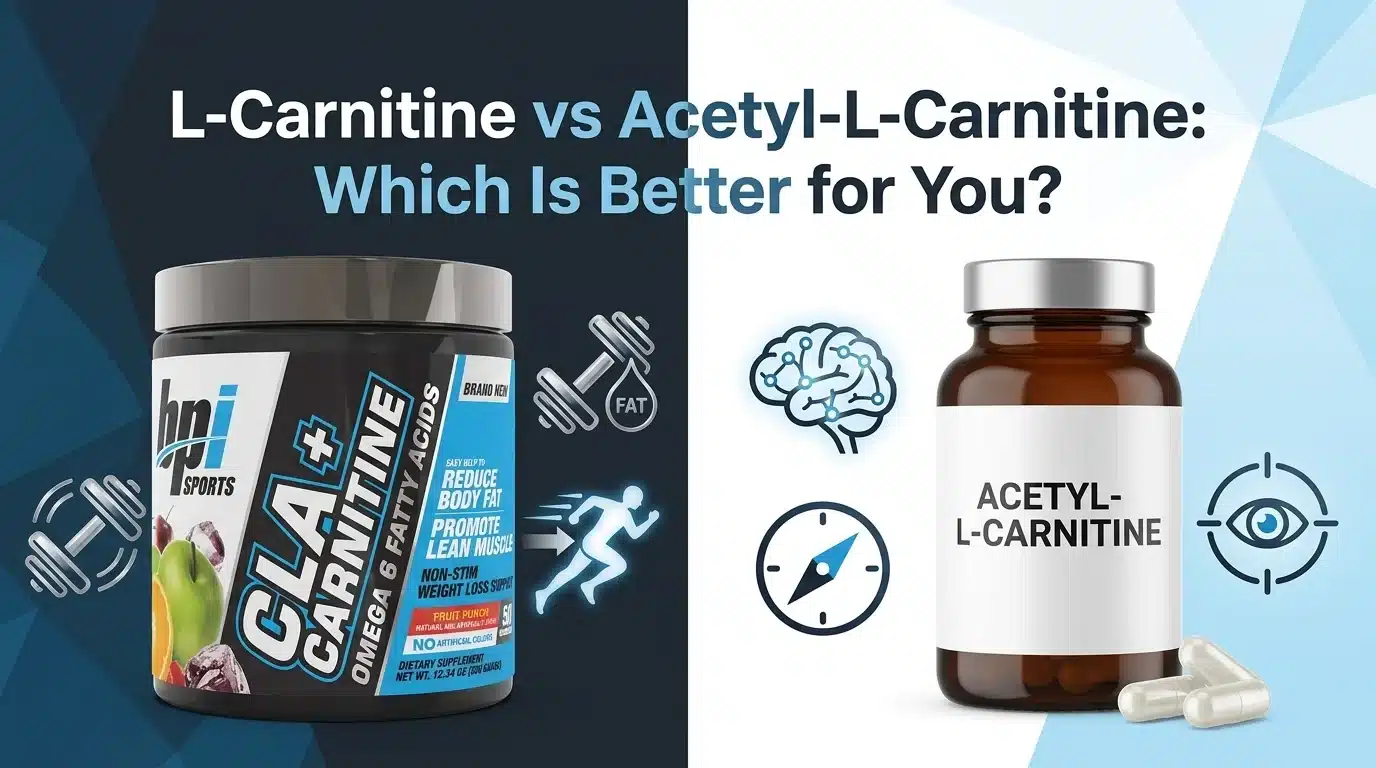
L-Carnitine vs Acetyl-L-Carnitine: Which Is Better for You?
Updated 17 November 2026
If you searched for L-Carnitine vs Acetyl-L-Carnitine, you are probably holding two supplement labels and wondering whether they are the same thing. They are related, but they are not interchangeable. Both are forms of carnitine, a compound your body uses to turn fat into energy. L-Carnitine is the standard form that is usually discussed for fatty-acid transport and exercise. Acetyl-L-Carnitine (ALCAR) carries an extra acetyl group and is usually discussed for brain and nerve research. This guide explains the biochemistry in plain language, what the evidence does and does not show, how to read dosage and labels, and how to check an original L-Carnitine supplement in Pakistan.
Quick Answer: L-Carnitine vs Acetyl-L-Carnitine
- L-Carnitine is the form most often chosen by people interested in fat metabolism, training energy and exercise recovery.
- ALCAR is the form most often studied for cognitive and neurological questions, partly because it is described as able to cross the blood-brain barrier.
- Neither is automatically better. They are different forms with different research contexts, and the evidence for both is mixed. The right choice depends on your goal, the product label and your health situation.
| Factor | L-Carnitine | Acetyl-L-Carnitine (ALCAR) |
|---|---|---|
| What it is | Standard carnitine | Carnitine with an added acetyl group |
| Commonly discussed for | Fatty-acid transport, metabolism, exercise | Brain energy metabolism, cognition research |
| Blood-brain barrier | Limited transport | Commonly described as able to cross |
| Evidence status | Mixed for performance and weight loss | Mixed for memory and cognition |
| Ranges reported on labels and in studies | Often 1 to 3g per day | Often 500 to 2,000mg per day |
What Is Carnitine and What Does It Do?
Carnitine is a compound made in the liver and kidneys from the amino acids lysine and methionine. It is also found in food, mainly red meat, poultry, fish and dairy. Its best-known job is to carry long-chain fatty acids into the mitochondria, the energy centres of your cells. Inside the mitochondria, those fats go through beta-oxidation and help produce ATP, the molecule your cells use as energy. About 95% of the body’s carnitine is stored in heart and skeletal muscle, which explains why it is linked with exercise.
Here is the part many supplement pages skip: healthy adults generally make all the carnitine they need. Supplements are therefore not correcting a shortage in most readers. Research instead asks whether extra carnitine changes outcomes such as exercise capacity, body composition or cognition, and the answers so far are mixed.
Carnitine is also a family of compounds, not one ingredient. The main forms you will meet are free L-Carnitine, L-Carnitine L-tartrate (common in sports products), Acetyl-L-Carnitine (acetylcarnitine) and propionyl-L-carnitine. Your body also makes acyl-L-carnitines, which are carnitine attached to different fatty acids. This guide focuses on the two forms most shoppers compare.

Carnitine often appears in products from the fat burner supplements category, but a supplement label is not proof of fat loss. Calorie balance, diet quality and training still decide body-weight outcomes.
What Is L-Carnitine?
L-Carnitine is the standard form that most people mean when they say “carnitine.” Its core role is carrying long-chain fatty acids into mitochondria so they can be used for energy. In supplements it appears as plain L-Carnitine (base or fumarate) and as L-Carnitine L-tartrate, and it is sold as capsules, tablets, powder and liquid.
Because carnitine sits in muscle tissue, L-Carnitine is the form people usually pair with training and cutting phases. For the full mechanism, see our guide to L-Carnitine for metabolism and energy production. If you are also weighing a fat-loss stack, our L-Carnitine vs CLA comparison explains how the two ingredients differ.
What Is Acetyl-L-Carnitine (ALCAR)?
Acetyl-L-Carnitine is L-Carnitine with an acetyl group attached. That small chemical change is the reason it is studied differently. ALCAR is commonly described as able to cross the blood-brain barrier, the protective filter between the bloodstream and brain tissue, so researchers have looked at its role in neuronal energy metabolism and mitochondrial function. The acetyl group can also be used to make acetyl-CoA, a molecule involved in energy production and in building the neurotransmitter acetylcholine.
This is a rationale for research, not a promise of results. Studies of ALCAR for memory, attention and cognitive decline have produced mixed findings, and it should not be treated as a way to prevent or treat dementia or any neurological disease. The NIH Office of Dietary Supplements also notes that the bioavailability of ALCAR has not been well studied, so claims that it is absorbed better than L-Carnitine are not firmly established.
L-Carnitine vs Acetyl-L-Carnitine: Key Differences
| Attribute | L-Carnitine | Acetyl-L-Carnitine (ALCAR) |
|---|---|---|
| Chemical form | L-carnitine | Acetylated form of L-carnitine |
| Core biological context | Fatty-acid transport into mitochondria, fat metabolism | Carnitine metabolism plus acetyl-group-related properties |
| Research focus | Metabolism, exercise outcomes, selected clinical contexts | Cognitive and neurological research, other clinical contexts |
| Common supplement positioning | Fat loss support, training energy, recovery | Focus, memory, mental fatigue |
| Evidence limits | Athletic performance and weight-loss studies show mixed results | Cognitive studies show mixed results; not a treatment for disease |
| How to choose | Match the product form and purpose to your goal | Check the evidence, label and clinician advice where relevant |

ALCAR is not simply a “better” L-Carnitine. It is a different form that researchers study for different questions. Choosing the stronger-sounding label does not make the choice smarter.
Which Form Is Better for Fat Loss, Exercise or Cognitive Support?
Fat loss
Carnitine is involved in fatty-acid metabolism, so L-Carnitine is the form shoppers usually consider first for a cutting phase. The mechanism does not guarantee weight loss, though. Trials have had varied results, and body-fat change depends mainly on calorie intake, diet quality and activity. If you are building a fat-loss plan, our CLA and L-Carnitine combination guide covers how people stack the two, and CLA supplements are a separate ingredient, not a carnitine form.
Exercise and recovery
Researchers have examined whether carnitine helps muscles work more efficiently and recover from hard sessions. According to the NIH Office of Dietary Supplements, studies on athletic performance have had mixed results. L-Carnitine may suit endurance-minded or calorie-restricted trainees who want to try it, but it is a possible support, not a substitute for training, sleep and food.
Cognitive support
ALCAR is the form linked with attention, mental fatigue and memory research because of its brain-related chemistry. Findings are mixed, and results vary by age, health status and dose. Anyone with memory concerns or a neurological condition should speak to a doctor rather than self-treat with a supplement.
What Does the Scientific Evidence Say?
It helps to separate three levels of certainty.
- Well established: carnitine carries long-chain fatty acids into mitochondria, and healthy adults make enough of it.
- Studied with mixed results: supplemental carnitine for exercise performance, body composition and, for ALCAR, cognition.
- Still uncertain: whether healthy people gain a meaningful real-world benefit, and whether ALCAR offers advantages over L-Carnitine in people without a clinical need.
One more detail matters: the NIH Office of Dietary Supplements reports that carnitine from supplements is absorbed far less efficiently than carnitine from food. A plausible mechanism in the body does not prove a noticeable result from a capsule, which is why expectations should stay realistic.
Dosage, Timing and How to Read Supplement Labels
There is no universal dose for everyone. Supplement labels and studies commonly report about 1 to 3g per day of L-Carnitine and about 500 to 2,000mg per day of ALCAR, often split into two servings. Treat these as ranges reported in some supplement contexts, not as a personal prescription. The most reliable instruction is the one printed on your product label, and a doctor can advise if you have a health condition or take medication.
When you read a label, check four things:
- The exact form: L-Carnitine, L-Carnitine L-tartrate, Acetyl-L-Carnitine or a blend. They are not the same ingredient.
- Milligrams per serving: compare the amount in one serving, not just the bottle size.
- Servings per container: this decides your real monthly cost.
- Other ingredients: combination products may add caffeine or other compounds that change tolerance.
Timing is flexible. Many people split doses and take them with food to reduce stomach upset, and carnitine works gradually, so any judgement about it needs weeks, not days. Total daily intake matters more than the clock.
Side Effects, Precautions and Medication Interactions
Carnitine is well tolerated by many people, but possible effects include nausea, vomiting, abdominal cramps, diarrhoea and a fishy body odour, particularly at higher intakes. The odour is linked to gut bacteria breaking down excess carnitine into compounds such as TMAO, and lowering the dose often helps.
Take extra care in these situations:
- Seizure disorders: the NIH Office of Dietary Supplements notes that carnitine may increase seizure risk in people with a seizure disorder.
- Kidney disease: high amounts can cause muscle weakness in people with chronic kidney disease.
- Medications: carnitine may interact with some medicines, including blood thinners and thyroid medication. Tell your doctor or pharmacist about every supplement you use.
- Pregnancy, nursing or a medical condition: speak to a qualified healthcare professional first.
How to Choose an Original L-Carnitine Supplement in Pakistan
Counterfeit and mislabelled products are a real risk in the local market, so quality matters as much as the form you pick. Use this checklist before you buy:
- Confirm the supplement facts panel names the exact carnitine form and the milligrams per serving.
- Check the batch number, expiry date and seal, and compare packaging with the brand’s official markers.
- Look for importer or distributor details on the pack and buy only from an authorised seller.
- Compare cost per serving, not only the sticker price.
For a deeper walkthrough, read how to identify original imported supplements. SportsOne is an importer and distributor, and you can browse genuine Imported Supplements in Pakistan in one place. One example from the L-Carnitine category is Sanaxium Nutrition Gold L-Carnitine 500mg (60 capsules), which was listed at PKR 3,900 on 17 November 2026. Prices change with the exchange rate, so confirm the current listing before you order. Stock of specific carnitine forms also changes, so check the live category for what is available today. If you want help matching a product to your goal, contact the SportsOne team.
Frequently Asked Questions
Is Acetyl-L-Carnitine better than L-Carnitine?
Not universally. They are different forms with different research contexts. The better choice depends on your goal, the evidence for that outcome, product quality and your health situation. Ask a healthcare professional if you take medication.
What is the main difference between L-Carnitine and ALCAR?
ALCAR has an acetyl group attached to carnitine and is studied in relation to the nervous system as well as energy metabolism. L-Carnitine is commonly discussed for fatty-acid transport and metabolic functions in muscle and other tissues.
Can L-Carnitine help with fat loss?
Carnitine is involved in fatty-acid metabolism, but this does not guarantee weight loss. Research results vary, and calorie balance, diet quality and physical activity remain central to managing body weight. Treat it as a possible support only.
Does Acetyl-L-Carnitine cross the blood-brain barrier?
ALCAR is commonly described as able to cross the blood-brain barrier, which is one reason it has been studied in cognitive and neurological contexts. This does not mean it guarantees better memory, focus or mental clarity for every person.
Can you take L-Carnitine and ALCAR together?
There is no universal need to combine them. They are related forms, so consider total intake, product labels, possible side effects and advice from a healthcare professional before stacking supplements, especially if you take medication.
Final Verdict: Which Form Fits Which Goal?
L-Carnitine is the more natural fit if your interest is fat metabolism, training energy or recovery. ALCAR is the form to look at if your question is about brain energy, focus or mental fatigue. Both have mixed evidence, neither replaces diet, training or medical care, and neither is automatically better than the other. Start from your goal, read the label for the exact form and dose per serving, and check with a healthcare professional if you have a condition or take medication. When you are ready to compare options, browse the L-Carnitine supplements range.
This article is for general educational purposes and is not medical advice. Research findings vary by population and outcome. Follow the product label and speak with a qualified healthcare professional before using carnitine supplements if you have a medical condition, take medication or have a history of seizures.
Sources and Methodology
Scientific statements in this guide follow the NIH Office of Dietary Supplements: Carnitine fact sheet for health professionals and Carnitine fact sheet for consumers. Product details come from the SportsOne L-Carnitine category as listed on 17 November 2026.


About author

Related posts

You do not need a gym membership to get stronger. This home workout plan for Pakistan uses only your bodyweight, a chair, a wall and... Continue reading

Clear whey looks like juice, drinks like juice and still delivers whey isolate protein. Regular whey looks and tastes like a milkshake. If you are... Continue reading

Search for drap registered supplements pakistan and you will find a lot of confident claims and very little explanation. Sellers say “DRAP approved” on banners,... Continue reading

Ramadan does not stop your training, but it squeezes everything into two short windows. Most gym members guess their way through the month: protein at... Continue reading

Yes, you can take whey protein in Ramadan, but only in your eating window. Whey protein in Ramadan works best when it is taken between... Continue reading
Add comment