
No products in the cart.
Return To Shop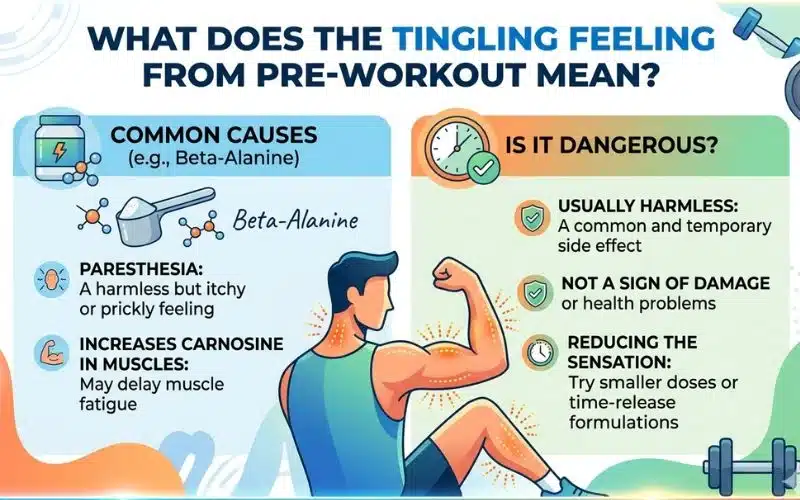
What Does The Tingling Feeling From Pre-Workout Mean Is It Dangerous?
That tingling is called paresthesia, caused by beta-alanine activating nerve receptors (MrgprD) in your skin. It is not dangerous. It’s a harmless, well-studied neurological side effect with zero serious adverse events reported in clinical trials at standard doses.
15–20 min
Onset after ingestion
45–90 min
Duration of tingling
3.2–6.4 g
Typical beta-alanine dose
0
Serious adverse events in trials
What Is Actually Happening in Your Body?
When you take a pre-workout supplement containing beta-alanine, the compound enters your bloodstream rapidly and travels to your skin’s sensory nerve endings. There it binds to a specific receptor called MrgprD, a G-protein coupled receptor that responds to beta-alanine by generating electrical signals your brain interprets as prickling, itching, or warmth.
This is pure neurology, not toxicology. The same mechanism that makes your hand “fall asleep” when compressed is at work here. Instead of pressure, it’s a chemical signal triggering the sensory neurons selectively.
Affected areas
High intensity: face, ears, scalp, chest, neck
Moderate: hands, forearms, feet
Tingling is strongest where MrgprD nerve endings are densest. Intensity varies by dose and individual sensitivity.
Which Ingredients Cause Which Sensations?
Not all pre-workout sensations come from the same source. Understanding which compound causes what helps you manage your experience and troubleshoot any discomfort effectively.
Beta-Alanine
Tingling / paresthesia
Activates MrgprD receptors in skin sensory neurons. Strongest in face, ears, and hands. Carnosine synthesis in muscles is the actual performance benefit. The tingle is merely a side effect.
Niacin (Vitamin B3)
Flushing / warmth
Causes vasodilation, meaning the widening of blood vessels. Produces a warm, flushed sensation on the skin surface. Often confused with beta-alanine tingling but feels more like heat than prickling.
Caffeine
Alertness / mild heart rate increase
Blocks adenosine receptors. Not directly responsible for tingling, but amplifies overall sensory awareness, making beta-alanine paresthesia feel more intense than it would alone.
Citrulline / Arginine
Muscle pump / vasodilation
Increase nitric oxide production, dilating blood vessels. Creates a mild tingling or pressure sensation in muscles during exercise, which is distinct from beta-alanine paresthesia.
Myths vs. Facts
The fitness industry is rife with misconceptions about pre-workout tingling. Let’s clear them up with what the science actually says.
| Myth | Fact |
|---|---|
| The tingling means it’s working | Paresthesia is a side effect, not an efficacy marker. Performance benefits come from muscle carnosine buildup over weeks, not from the tingle itself. |
| Tingling = allergic reaction | True allergic reactions cause hives, swelling, or breathing difficulty. Paresthesia is neurological, not immunological. It is a completely different mechanism. |
| No tingle = low quality supplement | Beta-alanine can be dosed below the paresthesia threshold and still be effective. Some products use split dosing specifically to avoid the tingle while maintaining benefit. |
| Tingling is dangerous or toxic | No serious adverse events reported in clinical trials at standard doses (3.2–6.4 g/day). The response is fully reversible and fades as beta-alanine clears the system. |
| More tingling = higher quality | Intensity only reflects dose and individual nerve sensitivity, not the product’s effectiveness or purity in any meaningful way. |
When Should You Actually Be Concerned?
Paresthesia itself is never a reason to worry. However, certain pre-workout situations do warrant attention and action beyond simply waiting for the sensation to fade.
| Situation | Risk Level | What to Do |
|---|---|---|
| Normal beta-alanine tingle, face/hands | Safe | Nothing required. Fades in 45–90 min naturally. |
| Tingling + chest tightness or breathlessness | See a doctor | Could indicate cardiac or allergic response. Stop use immediately and seek care. |
| Heart racing, severe anxiety, tremors | Caution | Likely caffeine overdose. Check total dose. Above 600 mg in one serving can be toxic. |
| Hives, swelling, itching (not paresthesia) | See a doctor | True allergy to an ingredient, possibly fillers, dyes, or proprietary blend compounds. |
| Heavy daily use (6+ g/day) over years | Monitor | Long-term data beyond 2 years is limited. Consider cycling off for 4–6 weeks periodically. |
How to Reduce the Tingling If You Dislike It
Paresthesia intensity is strongly dose-dependent and can be significantly reduced through simple adjustments without sacrificing any of the performance benefits.
1
Split your dose
Take 1.6 g of beta-alanine 2–4 times throughout the day instead of one large pre-workout dose. Studies show this maintains efficacy while staying below the paresthesia threshold for most users.
2
Take it with food
Food slows absorption and blunts the rapid blood spike that triggers intense paresthesia. A small carbohydrate snack 15–30 min beforehand is sufficient to noticeably reduce the sensation.
3
Use sustained-release formulations
SR beta-alanine products (e.g., CarnoSyn SR) release the compound over 45–90 minutes, reducing the peak blood concentration that activates MrgprD nerve receptors so intensely.
4
Build tolerance, it fades naturally
Many users report significant reduction in paresthesia after 2–4 weeks of consistent use at the same dose, suggesting neural adaptation to repeated MrgprD receptor activation over time.
Frequently Asked Questions
These are the most common questions people ask about pre-workout tingling, with full, research-backed answers.
Beta-alanine genuinely improves performance, but through a slow, cumulative mechanism, not an acute effect. It works by increasing muscle carnosine concentrations, which buffers hydrogen ions (H⁺) that accumulate during high-intensity exercise and cause that burning “muscle fatigue” feeling. A 2012 meta-analysis in Amino Acids (Hobson et al.) covering 15 studies found beta-alanine significantly improved exercise capacity in efforts lasting 60 seconds to 4 minutes, the exact range where hydrogen ion accumulation is the primary limiter. Benefits peak after 4–6 weeks of consistent dosing at 3.2–6.4 g/day. The tingling you feel immediately after taking it has no correlation to this carnosine-building process. It is purely a vascular nerve side effect and not a predictor of efficacy.
MrgprD (Mas-related G-protein coupled receptor member D) is a sensory receptor found on a specific subset of unmyelinated C-fiber neurons in the skin. It was originally identified as a receptor involved in itch sensation. A landmark 2012 study in the Journal of Neuroscience (Liu et al.) demonstrated that beta-alanine is a potent, selective agonist for MrgprD, meaning it binds to and activates this receptor with high specificity. When beta-alanine binds, it triggers an action potential in the nerve fiber, which travels to the dorsal horn of the spinal cord and up to the brain, where it’s interpreted as tingling, prickling, or mild itch. The receptor is most densely expressed in the face, scalp, chest, and extremities, which explains why those areas feel the effect most strongly. Importantly, MrgprD activation has no cardiovascular, hepatic, or renal consequences. It is purely a sensory phenomenon.
While beta-alanine tingling is harmless, some pre-workout ingredients have genuine safety concerns. Stimulants beyond caffeine are the biggest risk area: DMAA (1,3-dimethylamylamine) has been linked to hemorrhagic stroke and heart attack, and the FDA has issued multiple warning letters and seized products containing it. DMHA (dimethylhexylamine) and DMBA are structurally similar compounds still found in some aggressive pre-workouts with comparable risk profiles. Synephrine at high doses (above 50 mg) can elevate blood pressure and heart rate dangerously, especially combined with caffeine. Yohimbine is another stimulant that can cause severe anxiety, hypertension, and tachycardia in sensitive individuals or at high doses. On the banned substance side, athletes subject to testing should check every pre-workout against the WADA prohibited list, as several products have tested positive for trace amounts of amphetamine derivatives. Always verify ingredients on examine.com or Labdoor before purchasing.
Caffeine blocks adenosine receptors in the brain and heart, which reduces the calming signal that normally keeps heart rate lower during rest. This typically raises heart rate by 5–15 BPM at moderate doses (100–300 mg). For most healthy adults, this is well within safe limits. The FDA considers 400 mg/day a safe upper limit for healthy adults. Many pre-workouts contain 200–350 mg per serving, placing them in a reasonable range for most users. Problems arise with stacking: if you consume coffee before your pre-workout, or take multiple servings, you can approach or exceed toxic doses. Caffeine toxicity symptoms begin above 600 mg in a single session and include severe tachycardia, tremors, vomiting, and in extreme cases (above 10 g), cardiac arrest. People with pre-existing arrhythmias, hypertension, or anxiety disorders should use significantly lower doses or avoid stimulant-based pre-workouts entirely and consult a physician first.
If you want to avoid paresthesia entirely, look for pre-workouts that either omit beta-alanine altogether or use a sustained-release version. Effective stimulant-free or low-tingle alternatives include: (1) Creatine monohydrate, the single most evidence-backed performance supplement for strength and power; (2) Citrulline malate at 6-8 g, which improves blood flow, reduces exercise-induced fatigue, and has no tingling side effects; (3) Caffeine alone or with L-theanine, since the combination provides clean energy and focus without the jitteriness of caffeine alone; (4) Betaine anhydrous at 2.5 g, shown to improve power output in multiple studies with no paresthesia; (5) Rhodiola rosea, an adaptogen that reduces perceived exertion and mental fatigue. Brands known for transparent, tingle-free formulas include Legion Athletics, Transparent Labs (their non-beta-alanine variants), and Raw Nutrition. Always check the label, as even “non-stimulant” pre-workouts can sneak in beta-alanine.
Muscle carnosine loading with beta-alanine is a slow, dose-dependent process that cannot be rushed. At standard doses of 3.2–6.4 g/day, research shows the following progression: after 2 weeks of consistent use, muscle carnosine increases by approximately 20–30%. After 4 weeks, 40–60%. After 10–12 weeks of continued use, concentrations can reach 60–80% above baseline, where most of the meaningful performance benefits manifest. The tingling you feel on day one is a nerve receptor event and has nothing to do with this gradual carnosine accumulation. Individual variation is significant: people with naturally higher baseline carnosine (typically males and those with more fast-twitch muscle fiber dominance) may see a smaller percentage increase but start from a higher baseline. Vegetarians and vegans tend to have lower baseline carnosine and can see larger relative gains from supplementation.
The paresthesia from beta-alanine itself poses no cardiovascular risk. It is a purely peripheral sensory nerve phenomenon with no effect on heart rate, blood pressure, or cardiac conduction. The MrgprD receptors activated by beta-alanine are skin sensory neurons, not autonomic nerve fibers or cardiac receptors. However, this does not mean pre-workout supplements are safe for people with heart conditions in general. The concern is the other ingredients that typically accompany beta-alanine: high-dose caffeine (200–350 mg per serving), synephrine, yohimbine, and other stimulants can meaningfully increase heart rate and blood pressure, which may be contraindicated depending on the specific cardiac condition. If you have arrhythmia, hypertension, a history of heart attack or stroke, or take cardiac medications, you should consult your cardiologist before using any stimulant-containing pre-workout. Beta-alanine used in isolation or in a stimulant-free context carries no known cardiac risk.
Scientific References
- Hobson RM, et al. (2012). Effects of beta-alanine supplementation on exercise performance. Amino Acids.
- Liu MZ, et al. (2012). MrgprD is activated by beta-alanine and mediates itch. Journal of Neuroscience.
- Dunnett M & Harris RC. (1999). Influence of oral beta-alanine supplementation on carnosine synthesis. Equine Veterinary Journal.
- Stellingwerff T, et al. (2012). Optimizing human in vivo dosing and delivery of beta-alanine supplements. Amino Acids.
- Trexler ET, et al. (2015). ISSN position stand: beta-alanine. Journal of the International Society of Sports Nutrition.
- Smith AE, et al. (2009). Effects of beta-alanine supplementation and high-intensity interval training on endurance performance. Journal of Strength and Conditioning Research.





Add comment