
No products in the cart.
Return To Shop
How to Identify Original Imported Fish Oil Supplements
Updated: 21 August 2026
Buying fish oil supplements in Pakistan has become confusing — almost every product on the shelf claims to be “originally imported.” Knowing how to identify original imported fish oil supplements is the only way to avoid fake, expired, or diluted omega-3 products that deliver little to no health benefit.
This guide covers the checks you can run before and after purchase, plus a dosage-and-safety section written for people who already own a bottle and want to know if it’s working. Sports One reviews Imported Supplements in Pakistan as part of a broader effort to help buyers separate genuine, tested omega-3 from repackaged or oxidized stock.
Why Counterfeit Fish Oil Is a Real Problem in Pakistan
Fish oil is among the most counterfeited supplement categories in the country. Many bottles sold as “imported” are actually locally repackaged, carry relabeled expiry dates, contain very low EPA and DHA per serving, or have been stored badly enough to oxidize and turn rancid. None of this shows up on the front label — you have to know where to look.

What Makes Fish Oil “Fake” or Low Quality?
- Oxidized or rancid oil
- Misleading labels — “1000 mg fish oil” with no EPA/DHA breakdown
- No third-party testing (IFOS, NSF, USP)
- Refilled or tampered packaging
- No traceable importer or batch record
Low-quality fish oil doesn’t just underperform — oxidized oil can increase inflammation instead of reducing it, which defeats the point of taking it.
Quick Authenticity Checklist (2-Minute Test)
Before you buy, check for:
- Intact tamper seal
- Clear manufacturing and expiry dates (printed, not stickered)
- A batch or lot number
- An importer sticker with a physical address
- A scannable barcode or QR code
- EPA and DHA values listed separately, not just “total fish oil”
If two or more of these are missing, treat it as a red flag and look elsewhere.
Step-by-Step: How to Identify Original Imported Fish Oil Supplements
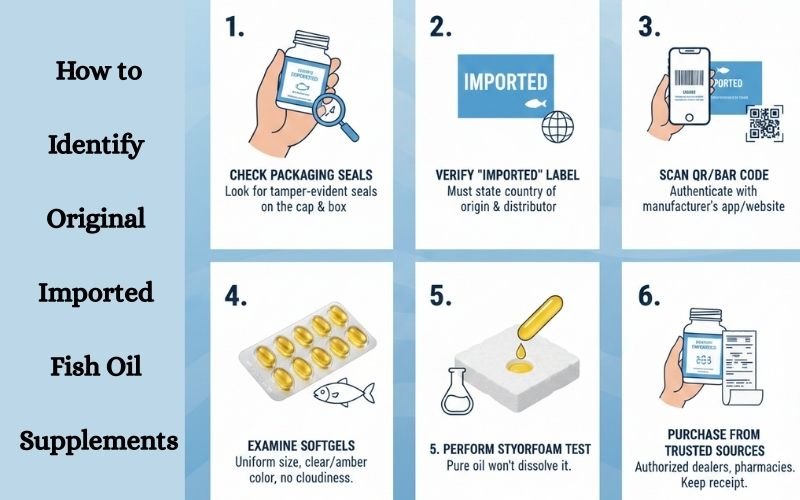
1. Match the Brand’s Official Packaging
Original imported stock matches the exact product images on the brand’s own website — same fonts, same label layout, same color tone. Any visible mismatch is a warning sign.
2. Verify Batch/Lot Number and Expiry Dates
Authentic fish oil has printed (not stickered) batch numbers and manufacturing/expiry dates that a brand or importer can trace back to a shipment.
3. Look for Third-Party Testing (IFOS, NSF, USP)
Genuine imported fish oil is usually third-party tested. Look for an IFOS rating, an NSF or USP mark, or a downloadable Certificate of Analysis (COA).
4. Confirm EPA + DHA Per Serving
Ignore “1000 mg fish oil” on its own — that number includes filler oil. Check the actual EPA amount, DHA amount, and combined EPA + DHA, ideally 500–1000 mg per serving.
5. Identify the Form: Triglyceride vs Ethyl Ester
Triglyceride (TG) form is better absorbed, more stable, and what most premium imported brands use. Ethyl Ester (EE) is cheaper to produce and oxidizes faster.
6. Inspect Packaging Quality
Original imported fish oil ships in tight tamper-sealed bottles with thick walls or premium blister packs and caps with ring locks. A loose cap or a seal that peels too easily is a red flag.
7. Barcode or QR Scan — With Caution
A barcode scan only confirms product registration, not authenticity. Pair it with importer verification and a batch-number check before you trust it.
8. Verify the Importer and Distributor
Look for the importer’s name, NTN or registration number, a physical address, and a stated warranty or replacement policy.
9. Evaluate the Seller
A trustworthy seller gives you a proper invoice, a clear return policy, evidence of cold-chain handling, and reviews you can actually verify.
Expert Guide: Dosage, Timing, and Safety for Imported Fish Oil
Identifying a genuine bottle is only half the job — using it correctly is what determines whether you get any benefit from it. For most healthy adults, a combined EPA + DHA intake of 500–1000 mg per day is the range cited in most quality guidelines for general heart, brain, and joint support; people managing high triglycerides are sometimes guided toward higher doses, but that decision belongs with a doctor, not a label. As a real-world reference point, Sanaxium Nutrition Gold Omega-3 (60 softgels, ₨ 3,900), currently in stock at Sports One, lists its EPA/DHA per softgel on the bottle rather than burying it inside a vague “fish oil 1000 mg” figure — that’s the kind of label transparency this guide recommends checking for.
Timing: Take fish oil with a meal that contains some fat. Omega-3s are fat-soluble, so absorption is measurably better with food than on an empty stomach. Splitting the daily dose across two meals (rather than one large dose) also tends to reduce the fishy-burp effect that puts people off taking it consistently.
Safety notes: Fish oil has a mild blood-thinning effect at high doses, so anyone on anticoagulants, preparing for surgery, or managing a bleeding disorder should check with a doctor before starting. Pregnant or breastfeeding women should choose a product with a verified low-mercury sourcing statement — a genuine importer will be able to show this. Stop use and consult a doctor if you notice unusual bruising, prolonged bleeding from small cuts, or persistent digestive discomfort.
Storage: Keep the bottle away from heat and direct light, and refrigerate it after opening if the label suggests it — this is one of the simplest ways to slow oxidation once the tamper seal is broken.
Signs Your Fish Oil Is Rancid or Oxidized
Even genuinely imported fish oil can go bad if it’s stored incorrectly — heat, light, and prolonged air exposure are the usual causes. Watch for a strong fishy or paint-like smell, a burning sensation in the throat, nausea, headaches, or capsules that look cloudy or have started leaking. If you notice any of these, stop using the product; oxidized fish oil can increase inflammation instead of reducing it and offers no real EPA/DHA benefit.
Imported vs Local Fish Oil: What “Imported” Really Means
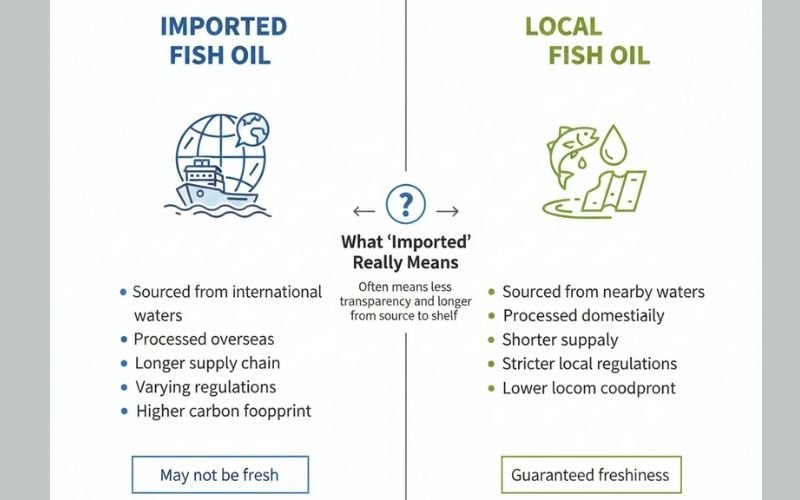
Not every bottle labeled “imported” is fully imported. There are three categories worth knowing:
- Fully imported finished product — manufactured and packaged abroad, sold as-is (best option).
- Imported raw oil, locally encapsulated — the oil is genuine, but quality now depends on local handling.
- Locally produced, foreign branding — the least transparent category; verify everything before buying.
Ask the seller which category a product falls into before you buy — a legitimate importer will know the answer immediately.
Compare Imported Fish Oil & Omega-3 Options at Sports One
Here’s how the imported omega-3 stock currently carried on-site compares on form, price, and testing signals:
| Product | Price | Servings | Good for |
| Sanaxium Nutrition Gold Omega-3 | ₨ 3,900 | 60 softgels | Everyday EPA/DHA support with a clearly labeled dose — currently in stock |
| ProScience Nutra Fish Oil | ₨ 3,900 | 100 servings | Budget-per-serving buyers (check stock before ordering) |
| ELEV Ultra Omega-3 | ₨ 4,200 (was ₨ 4,700) | 90 capsules | Higher-potency formula shoppers (check stock before ordering) |
| Zoomadlabs Omega-3 | ₨ 4,500 | 90 tablets | Tablet-format preference over softgels (check stock before ordering) |
Prices and stock as listed on sportsone.com.pk at time of writing; always confirm current stock and batch details before ordering.
Label Reading Guide (Simple Explanation)
Correct label: “EPA 360 mg / DHA 240 mg,” a clear serving size, no vague wording.
Misleading label: “1000 mg fish oil” with no EPA/DHA breakdown at all.
What We Recommend
- Focus on quality indicators, not brand name or marketing claims
- Choose fish oil that’s IFOS or NSF tested for purity, safety, and freshness
- Confirm the label discloses EPA and DHA per serving, not just total fish oil weight
- Verify importer and distributor details — address, registration, traceability
- Check that packaging matches official brand images with no font or color inconsistencies
- Look for printed batch numbers and expiry dates, not stickers added later
- Confirm the retailer stores stock under proper conditions to prevent oxidation
Want to Know If Your Fish Oil Is Working?
The Omega-3 Index blood test measures actual EPA and DHA levels in your cells. It’s the most accurate way to confirm a supplement is doing anything at all, especially for long-term users.
FAQs: How to Identify Original Imported Fish Oil Supplements
Is expensive fish oil always original?
No. Price alone doesn’t confirm authenticity. Always verify batch numbers, third-party testing certifications, and official importer details before trusting a premium price tag.
Can local fish oil be good quality?
Yes — if it’s properly purified, third-party tested, and transparently labeled with clear EPA/DHA values and safety certifications. Consistency between batches, however, varies more than with established imported brands.
Do fishy burps mean fake fish oil?
Not always, but frequent fishy burps usually point to oxidation, poor formulation, or improper storage. Fresh, high-quality fish oil should cause minimal aftertaste.
Is IFOS certification mandatory?
No, but it’s strongly recommended. IFOS testing is one of the clearest independent signals of purity, freshness, and low oxidation in a fish oil product.
How long does original fish oil stay fresh?
Typically 24–36 months unopened and stored correctly. Heat, light, and air exposure all accelerate oxidation, so storage conditions matter as much as the expiry date.
Final Thought
Knowing how to identify original imported fish oil supplements is no longer optional — it’s essential in a market where counterfeits are common. Verify labels, testing, packaging, and sellers before you buy, and treat quality omega-3 as an investment worth confirming is genuine.


About author

Related posts

For most healthy adults, collagen peptides are well tolerated. The side effects people actually report are mild: a feeling of fullness, bloating, an aftertaste or... Continue reading

The short answer: the best time to take collagen is whichever time you will repeat every single day. Research on hydrolysed collagen peptides has not... Continue reading
Neither is universally better. Marine collagen is often preferred for skin, hair and people who avoid beef, while bovine collagen is usually cheaper and offers... Continue reading

Collagen may help support joint comfort in some people, but the evidence is modest, results are slow, and it is not a substitute for medical... Continue reading
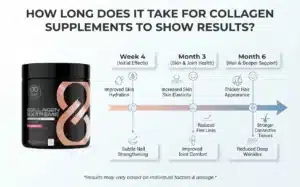
Most people notice their first change from collagen supplements after 4 to 8 weeks, with clearer skin and joint results building between 8 and 12... Continue reading
Add comment