
No products in the cart.
Return To Shop
Creatine Loading Phase: Do You Really Need It?
If you have ever opened a tub of creatine monohydrate, you have probably seen the instructions telling you to “load” for the first week. It sounds official, almost medical, so most beginners follow it without question. But is a creatine loading phase actually necessary, or is it a leftover marketing habit from decades-old research protocols? At SportsOne International, an authorised distributor of imported, Halal-certified creatine brands in Pakistan, we get this question constantly from first-time buyers. Here is the honest, evidence-based answer.
What Is a Creatine Loading Phase?
A creatine loading phase is a short period, usually five to seven days, where you take a higher-than-normal dose of creatine monohydrate to saturate your muscle creatine stores faster. The standard loading protocol used in most clinical studies is around 20g per day, split into four 5g servings, followed by a lower maintenance dose afterward.
The idea comes from early research in the 1990s that measured how quickly muscle creatine levels rose under different dosing strategies. Loading did work in those studies, but “worked faster” is not the same as “necessary.”

Creatine Loading Phase vs Maintenance Dose
This is where most of the confusion sits. A maintenance dose is the standard 3 to 5g per day that most lifters take indefinitely once their muscle stores are saturated. The core difference between a creatine loading vs maintenance dose approach is simple: loading gets you saturated in about a week, while a flat maintenance dose gets you to the same saturation point in three to four weeks. Both paths end at the same destination.
| Approach | Daily Dose | Time to Full Saturation | Common Side Effects |
| Loading Phase | ~20g (split into 4 doses) | 5 to 7 days | Bloating, water retention, mild stomach discomfort |
| Maintenance Only | 3 to 5g | 21 to 28 days | Minimal to none |
The Myth Behind the Loading Phase
The biggest myth is that skipping the loading phase means creatine “will not work” or that results will be permanently weaker. This is not accurate. Loading only changes the speed at which you reach full muscle saturation. It does not change the final amount of creatine your muscles can store, and it does not change your long-term strength or performance outcomes once you are saturated.
Another common myth is that loading is required for the compound to become active in the body, which ties into a broader misunderstanding of what makes creatine anabolic and how it supports protein synthesis. Creatine works the same way at any dose once your muscles are saturated; loading is purely a shortcut, not a switch that turns the supplement on.
Does Skipping the Loading Phase Slow Down Results?
Technically, yes, but only in the first few weeks. If you skip loading and go straight to a 3 to 5g daily dose, you will reach the same saturation level as someone who loaded, just two to three weeks later. For most recreational lifters, this delay makes almost no practical difference to strength or muscle gains over a full training cycle. For competitive athletes on a tight prep timeline, loading can make sense purely for the speed advantage.
Who Should (and Shouldn’t) Load Creatine
Loading is not risk-free for everyone. Higher doses increase the likelihood of bloating and mild gastrointestinal discomfort, and certain individuals should be more cautious with dosing altogether. We cover this in detail in our guide on who should not take creatine in Pakistan, which is worth reading before starting any protocol, loading or otherwise.
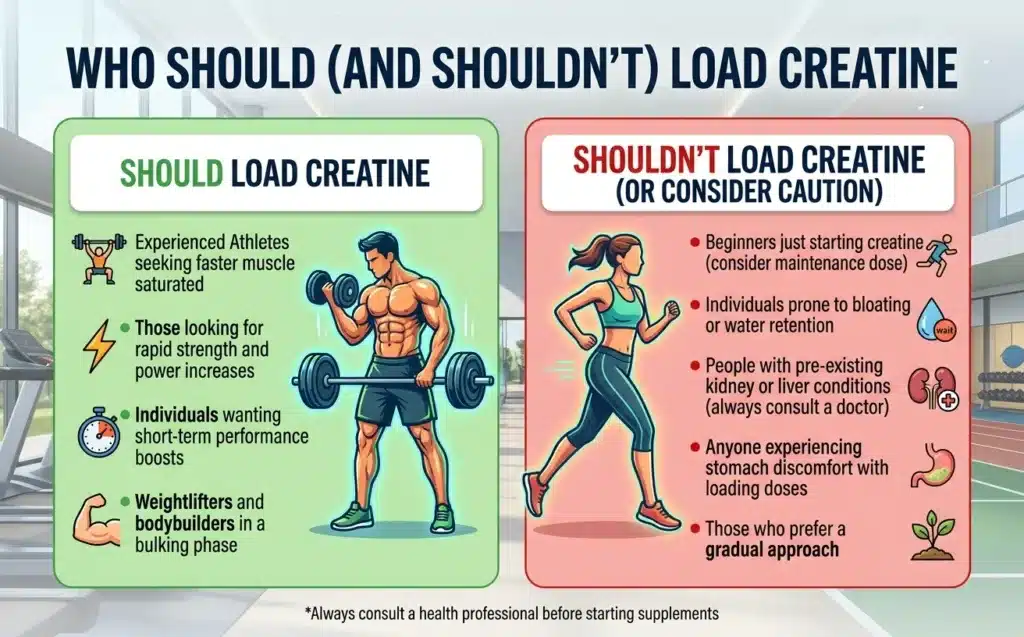
As a general rule:
- Beginners with no time pressure: skip loading, start with 3 to 5g daily
- Athletes with a competition or event within two weeks: loading can help
- Anyone sensitive to bloating or stomach upset: skip loading
- Anyone with pre-existing kidney concerns: consult a doctor before either approach
What Happens If You Stop or Change Your Dose
A lot of buyers also ask what happens once they stop taking creatine altogether, especially after a loading phase. Muscle creatine levels gradually decline over four to six weeks without supplementation, which we break down fully in what happens if you stop creatine suddenly. The short version: there is no dangerous rebound effect, just a slow return to your body’s natural baseline.
Choosing the Right Creatine for Loading or Maintenance in Pakistan
Whether you load or not, the quality of the creatine matters more than the protocol. Counterfeit and underdosed creatine is a documented problem in Pakistan’s grey market, which is why buying through an authorised, Halal-certified supply chain matters. SportsOne stocks genuine Optimum Nutrition Micronized Creatine for lifters who want a globally recognised, third-party tested option, alongside Sanaxium Nutrition Gold Creatine for a more budget-friendly, equally authentic alternative.
Every SKU in our creatine collection is imported and Halal-certified, so whichever dosing approach you choose, you are not gambling on purity or fill weight. If halal compliance is a deciding factor for you, our Halal creatine guide for Pakistan walks through certification standards brand by brand.
Final Verdict: Do You Really Need to Load?
For most people, no. A flat 3 to 5g daily maintenance dose gets you to the same muscle saturation as loading, just a few weeks slower, with fewer side effects and a simpler routine. Loading only earns its place if you genuinely need faster saturation for a short-term goal. Beyond that, it is optional, not essential, and definitely not a requirement for creatine to “work.”
Frequently Asked Questions
Do I need to do a creatine loading phase to see results?
No. Loading only speeds up how fast your muscles reach full saturation, usually by two to three weeks. A steady 3 to 5g daily dose reaches the same saturation point eventually, with the same long-term strength and performance benefits.
What is the difference between creatine loading and maintenance dose?
Loading uses about 20g per day for five to seven days to saturate muscles quickly. Maintenance uses 3 to 5g daily and reaches full saturation in three to four weeks. Both approaches end at the same saturation level.
Can skipping the loading phase cause side effects?
Skipping loading generally causes fewer side effects, not more. Loading phases are more likely to cause bloating, water retention, or mild stomach discomfort due to the higher daily dose split across multiple servings.
Is it safe to load creatine every time I restart supplementation?
It is generally safe for healthy individuals, but not necessary. Since maintenance dosing reaches the same saturation point within a month, most people can skip repeated loading phases and start straight at 3 to 5g daily.
Does the brand of creatine affect whether loading is needed?
No, loading protocols apply to creatine monohydrate generally, not specific brands. What matters more is buying authentic, properly dosed creatine from an authorised, Halal-certified source to avoid underdosed or counterfeit products.


About author

Related posts

For most healthy adults, collagen peptides are well tolerated. The side effects people actually report are mild: a feeling of fullness, bloating, an aftertaste or... Continue reading

The short answer: the best time to take collagen is whichever time you will repeat every single day. Research on hydrolysed collagen peptides has not... Continue reading

Neither is universally better. Marine collagen is often preferred for skin, hair and people who avoid beef, while bovine collagen is usually cheaper and offers... Continue reading

Collagen may help support joint comfort in some people, but the evidence is modest, results are slow, and it is not a substitute for medical... Continue reading
Most people notice their first change from collagen supplements after 4 to 8 weeks, with clearer skin and joint results building between 8 and 12... Continue reading
Add comment