
No products in the cart.
Return To Shop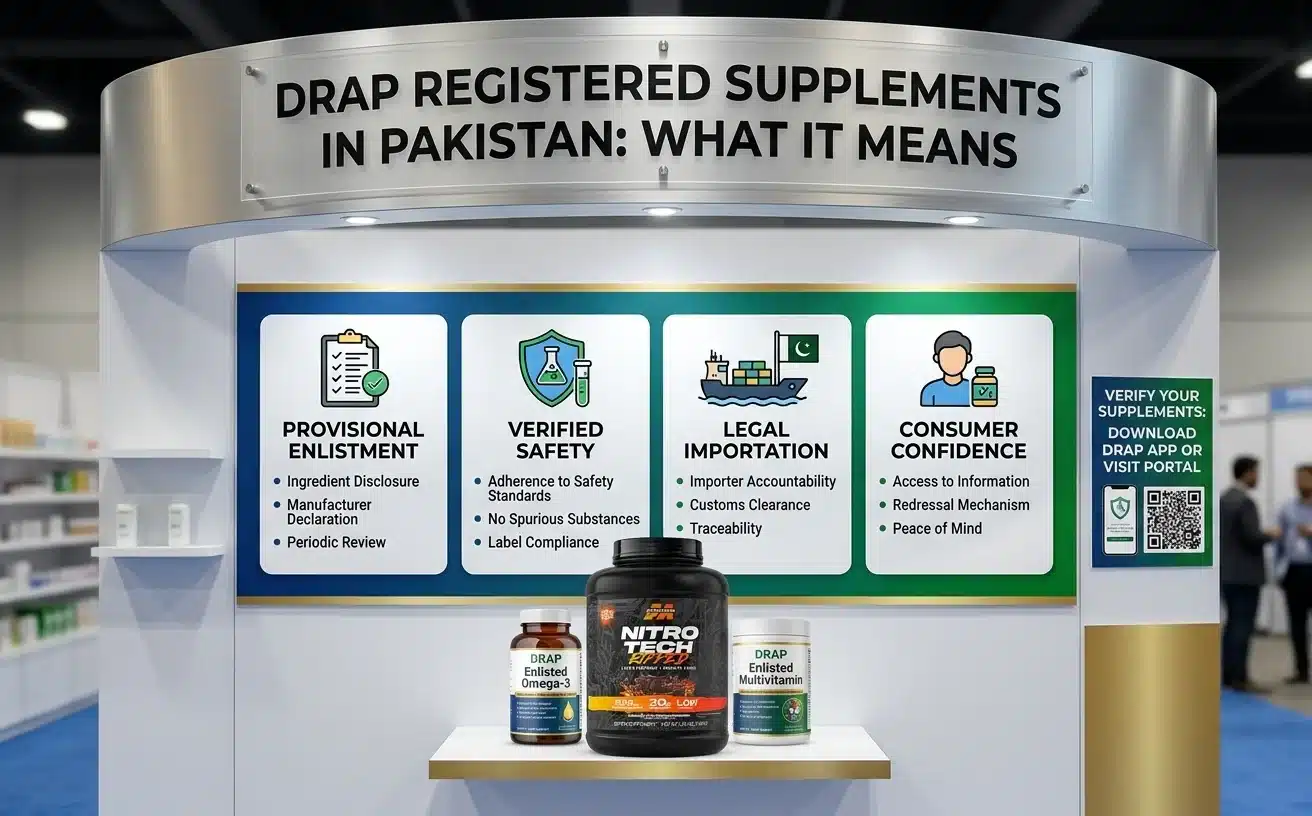
DRAP Registered Supplements in Pakistan: What It Means for Imported Products
Search for drap registered supplements pakistan and you will find a lot of confident claims and very little explanation. Sellers say “DRAP approved” on banners, yet few buyers know what the Drug Regulatory Authority of Pakistan actually checks, what paperwork should exist behind a tub of whey or creatine, or how to ask for proof. This guide explains it in plain terms so you can judge any seller, including us, on evidence. If you buy Imported Supplements in Pakistan, these are the questions worth asking every time.
What DRAP Is and What It Actually Regulates
DRAP was created under the DRAP Act 2012. Its Division of Health and OTC regulates alternative medicines and health products, and DRAP’s own product categories page lists food supplements and nutritional products among the health products it covers. The working rulebook is the Alternative Medicines and Health Products (Enlistment) Rules, 2014, issued as SRO 412(I)/2014.
Two points matter for shoppers. First, DRAP regulates the businesses and products that enter the market, not your individual purchase. Second, enlistment is a regulatory record. It is not a guarantee of results, and it does not mean every marketing claim on a label has been verified.

Registration vs Enlistment vs Import Authorization
People use “registered”, “approved” and “enlisted” as if they mean the same thing. They do not. Under the 2014 rules, the formal term for food supplements is enlistment. Here is how the three ideas differ in practice.
| Term | What it usually refers to | What to ask for |
| Registration | The term used for medicines. Shoppers often borrow it for supplements as shorthand. | Ask which category the product falls under. |
| Enlistment | DRAP’s record for health products and for the manufacturers and importers behind them. | Ask for the enlistment details and the importer’s name. |
| Import authorization | Clearance and paperwork needed when a consignment enters Pakistan. | Ask whether the stock came through a formal importer. |
Customs and DRAP have treated imported supplements as health products in public notices, so the paperwork trail is real. How a specific product is classified, for example a protein powder versus a capsule or tablet, can vary, which is why you should ask the seller rather than assume. Our guide to finding an official distributor of imported supplements covers the same checks from the buyer’s side.
What a Compliant Imported Supplement Carries on Its Label
A label cannot prove regulatory status on its own, but a missing label is a strong warning sign. A genuine imported pack should show:
- Product name, brand and manufacturer details
- Country of origin
- Full ingredient list and allergen information
- Net quantity and serving size
- Batch or lot number and expiry date
- Storage instructions
- Importer or distributor details applied for the Pakistani market
- A Halal logo, where the brand claims Halal certification
Check that the batch number on the tub matches the one on the outer carton, and that print quality, spelling and seals look consistent. Our step by step guide to verifying original imported supplements and the packaging walkthrough in authenticity checks for imported supplement packaging go deeper on this.
Why Grey-Market Stock Is Cheaper and What Is Skipped
Grey-market stock is genuine or claimed-genuine product that reaches shops outside the brand’s official distribution chain. It is often cheaper because the seller avoids costs that formal distributors carry. Depending on the route, the steps that can be skipped include:
- Importer enlistment and product clearance paperwork
- Controlled storage and transport, which matters in Pakistani summers
- Batch tracking back to the brand
- After-sale support when something goes wrong
None of this means every grey-market tub is fake. It means you cannot easily prove where it has been or whether it was handled properly. For the health side of the trade-off, read why buying cheap supplements can cost you your health, and for fakes specifically see how to identify fake imported supplements in Pakistan.
How Authorized Distribution Works End to End
In an authorized chain, the brand appoints a distributor for a territory. The distributor imports stock through the formal route, stores it, and supplies retailers or sells directly. Each step leaves a paper trail: purchase records, batch details and a named party who answers for the product.
SportsOne states on its site that it is the exclusive and authorized distributor in Pakistan for MuscleTech, Applied Nutrition and Sanaxium, and it lists the other brands it distributes on its all brands page. The details of how that model works are set out on our authorized distribution page.
You can see the result on the shelf. Popular lines such as whey protein in Pakistan and creatine come with a named seller you can visit, call or return to. Our store pages for Lahore, Karachi, Islamabad and Gujranwala show where that accountability sits in person.
Halal Certification and How It Sits Alongside DRAP
Halal certification and DRAP enlistment answer different questions. DRAP enlistment is about regulatory standing for sale in Pakistan. Halal certification, issued by a separate certifying body, is about whether ingredients and processing meet Islamic requirements. This matters for protein in particular, because whey, gelatin capsules and some flavourings raise questions that a regulatory record does not answer.
A trustworthy product can therefore carry both, one of them, or neither. Do not let a “DRAP approved” banner stand in for a Halal check, or the other way round. SportsOne states that the products it stocks are Halal certified, and we publish the details on the same authorized distribution page. For a buyer’s view, see our Halal supplement guide for Pakistani consumers and Halal whey protein in Pakistan.
What to Ask a Seller Before You Buy
You do not need a legal background to ask good questions. Treat the answers as a pattern: a seller with nothing to hide answers quickly and specifically. Vague answers, pressure to buy now or an unusually low price are reasons to pause.
- Who imported this stock? You want a named company, not “our supplier”.
- Are you an authorized distributor or retailer for this brand? Ask which brands, and whether the brand lists you.
- Can I see the enlistment or import paperwork for this product? If the seller cannot show it, ask what category they treat the product as.
- Is the Halal certificate available for this exact product? Ask to see it, not just hear about it.
- What are the batch number and expiry date? Compare them on the tub and the carton.
- How has it been stored? Heat damages protein, vitamins and pre-workouts.
- What is your return policy if the product is not genuine? A real distributor stands behind the stock.
If you are buying a brand with known counterfeits, use brand-specific checks too, such as our guide to checking original MuscleTech whey protein. You can also browse the full protein range knowing which questions to ask about each product.
Note: This article is general information, not legal advice. DRAP rules and procedures can change, so confirm current requirements with DRAP directly. Supplements are not a substitute for a balanced diet or medical treatment.
FAQs
What does DRAP registered mean for a supplement in Pakistan?
Strictly, DRAP enlists food supplements under its 2014 health products rules rather than registering them like medicines. Shoppers use registered for both. It means the importer or product is on record, not that DRAP endorses every claim on the pack.
How can I check if my supplement is DRAP registered?
Ask the seller for the enlistment or importer documents, then match the brand, product name and importer on them to your pack. If nothing can be shown, confirm with DRAP through its official channels before you buy or keep using it.
Is DRAP approved the same as Halal certified?
No. DRAP enlistment is a regulatory record for sale in Pakistan. Halal certification comes from a separate certifying body and checks ingredients and processing against Islamic requirements. A product can have one without the other, so verify both.
Is it legal to import supplements into Pakistan for resale?
Commercial importers of health products generally need DRAP enlistment and clearance before selling. Bringing a few tubs for personal use is different from importing stock to resell. Confirm current rules with DRAP or a customs adviser before importing.
Why is grey-market stock cheaper than authorized stock?
Grey-market stock often skips the costs of formal distribution: compliance paperwork, controlled storage, batch records and after-sale support. The saving can mean unknown storage history, no traceability and no recourse if the product is fake or expired.
About author

Related posts

Ramadan does not stop your training, but it squeezes everything into two short windows. Most gym members guess their way through the month: protein at... Continue reading

Yes, you can take whey protein in Ramadan, but only in your eating window. Whey protein in Ramadan works best when it is taken between... Continue reading
Most people guess their protein intake and guess wrong. This guide gives you protein in Pakistani foods per standard serving, from roti, daal and chicken... Continue reading
Walk into any supplement shop in Lahore, Karachi or Islamabad and the fat burner shelf is usually the busiest one. Packs in our current range... Continue reading

Walk into almost any gym in Lahore, Karachi or Islamabad and you will see school and college students lifting beside adults. Many of them are... Continue reading
Add comment