
No products in the cart.
Return To Shop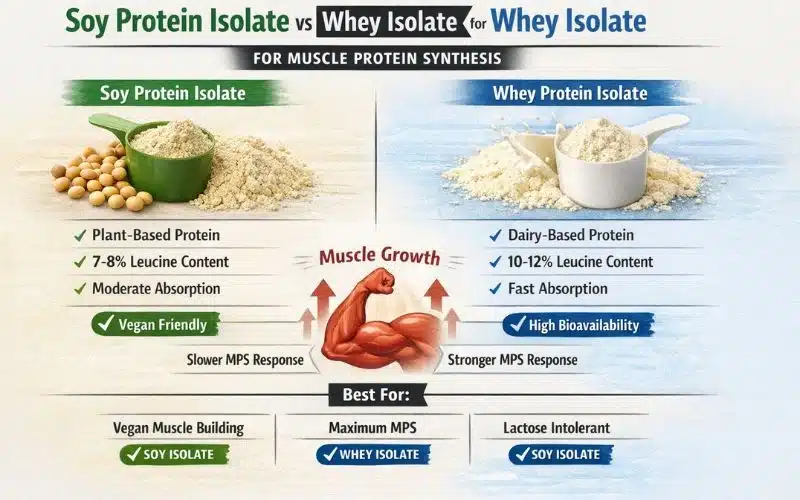
Soy Protein Isolate vs Whey Isolate for Muscle Protein Synthesis: Which Wins in 2026?
Last updated: October 15, 2026
Quick answer: whey isolate has a modest edge for acute muscle protein synthesis (MPS) because it has more leucine and digests faster. Over 8 to 12 weeks of training, soy protein isolate builds similar muscle when total protein intake is matched. Choose whey if you tolerate dairy, and soy if you are vegan or dairy-free.
Soy Isolate vs Whey Isolate: Quick Comparison for MPS
| Factor | Whey Isolate | Soy Isolate |
|---|---|---|
| Protein by weight | About 90%+ | About 90%+ |
| Leucine content | About 10 to 11% | About 7 to 8% |
| BCAA content | About 23 to 25% | About 17 to 18% |
| Digestion speed | Fast | Moderate |
| Acute MPS response | Higher | Slightly lower |
| Muscle gain over 8 to 12 weeks | Strong | Comparable at matched protein intake |
| Typical post-workout dose | 25 to 30g | 30 to 40g |
| Allergen | Dairy (almost lactose-free) | Soy |
| Best for | Max post-workout MPS, beginners, cutting | Vegans, vegetarians, dairy-free diets |
If you have ever stood in a supplement store comparing a tub of soy protein isolate with a tub of whey isolate, you are not alone. It is one of the most debated questions in sports nutrition, and the honest answer is more nuanced than most articles admit. Here is how the two compare on the science that actually matters.

What Is Muscle Protein Synthesis and Why Does It Matter?
Muscle protein synthesis is the process your body uses to repair and rebuild muscle fibers after training. When MPS outpaces muscle protein breakdown (MPB), you are in a net positive state, and that is what produces muscle gain over time. The amino acids from your protein supplements supply the raw material.
- Leucine threshold: roughly 2 to 3g of leucine per serving is needed to maximally trigger MPS. See how much leucine you need to trigger muscle protein synthesis.
- mTOR signaling: leucine activates the mTOR pathway, the main switch that starts MPS.
- Digestion speed: faster proteins raise blood amino acid levels sooner, which matters most after training.
- Essential amino acids (EAAs): all nine must be present for the repair cycle to complete.
Whey Isolate: The Benchmark for Muscle Protein Synthesis
Whey isolate comes from milk during cheese production and is filtered to remove nearly all lactose and fat, leaving a powder that is typically 90%+ protein. Its leucine content of about 10 to 11% by weight is among the highest of any natural protein, and its PDCAAS score is 1.0.
That leucine density is why a standard 25g scoop reliably reaches the leucine threshold. For the wider picture, read whey protein isolate benefits for muscle and fat loss. If dairy upsets your stomach, isolated protein for lactose intolerant individuals and how much lactose is in whey protein isolate explain why isolate is usually well tolerated.
Post-Workout: Where Whey Isolate Shines
Because whey isolate is absorbed quickly, plasma amino acids peak sooner after a shake. That speed is the main reason post-workout nutrition and why whey protein matters most remains standard advice for lifters.
- Digested and absorbed rapidly, with amino acids peaking within about 60 to 90 minutes
- Leucine content drives mTOR signaling more effectively than most plant alternatives
- Helps preserve lean muscle during a calorie deficit
- BCAA content supports recovery and may reduce muscle soreness (DOMS)
Soy Protein Isolate: The Plant-Based Contender
Soy protein isolate deserves more respect than gym culture gives it. It is a complete protein, with all nine essential amino acids, and it is the most widely studied plant protein for sports nutrition. Other plant foods such as quinoa and buckwheat are also complete, but soy is the one that comes as a high-protein, low-carb isolate powder.
Soy isolate is 90%+ protein by weight, with leucine around 7 to 8% and a PDCAAS of roughly 0.9 to 1.0. That is lower than whey on leucine, but still enough to stimulate MPS when the serving is large enough. If you eat a plant-based diet, see the benefits of plant-based proteins for weight loss and top plant-based sources of all 9 essential amino acids.
What the Research Says: Acute MPS vs Long-Term Muscle Growth
Short-term studies, including work by Tang and colleagues (2009) and Wilkinson and colleagues (2007), show whey or milk protein producing a larger MPS response than soy after exercise. The likely drivers are higher leucine and faster digestion.
Long-term results look different. A 2018 meta-analysis by Messina and colleagues found that soy and animal protein produced similar gains in lean mass and strength during resistance training, and a 2013 trial by Volek and colleagues reported comparable muscle gains on whey and soy. In practice, total daily protein, training quality and consistency matter more than the choice of isolate. For a Pakistan-focused view, see whey vs soy protein in Pakistan.
- Short-term (acute MPS): whey isolate has a moderate edge.
- Long-term muscle gain (8 to 12 weeks): comparable results when protein intake is matched.
- Recovery between sessions: whey isolate tends to show slightly faster recovery markers.
- Hormones: meta-analyses show soy isoflavones do not meaningfully change testosterone or estrogen in healthy men at normal intakes.
Who Should Choose Whey Isolate?
Whey isolate suits most people who want to maximize MPS, especially after training. It works well for beginners, intermediate lifters and anyone without a dairy allergy. If you are new to supplements, is whey protein isolate good for beginners covers the basics, and whey protein isolate for weight loss explains its value when cutting.
- Lactose-sensitive lifters who tolerate dairy-based isolate
- Athletes who prioritize post-workout recovery speed
- People with higher protein targets (1.6 to 2.2g per kg of body weight)
- Anyone who wants maximum protein with minimal carbs and fat

Who Should Choose Soy Protein Isolate?
Soy isolate is the practical choice for vegans, vegetarians and anyone avoiding dairy. It is also naturally low in saturated fat. For ideas on using it, try our vegan weight loss shakes, and see how to combine plant proteins for a complete amino acid profile.
- Vegans, vegetarians and flexitarians
- People with dairy allergies or whey sensitivity
- Anyone who wants to cut the environmental footprint of their diet
- Lifters who prefer a slightly slower amino acid release between meals
Expert Guide: Dosage, Timing and Safety
The better protein will still underperform if dose and timing are wrong. The key idea is simple: aim to hit about 2.5 to 3g of leucine in the post-workout serving, then meet your daily protein target. Both are far more important than choosing the “perfect” isolate.
Dose: a 25 to 30g scoop of whey isolate usually delivers about 2.5 to 3g of leucine. Soy isolate has less leucine per gram, so 30 to 40g is the usual way to reach the same threshold. If you use soy, you simply scoop a little more.
Timing: take whey isolate within 60 minutes of training, when muscles are most responsive. Soy can be used the same way, or between meals, where its moderate digestion helps you feel full. Spreading 20 to 40g servings across 3 to 4 meals supports MPS better than one huge dose. See how much protein per day for a beginner to set your daily total, and whether you need whey if you already eat chicken daily if whole foods cover most of it.
Before bed: casein digests slowest and suits overnight recovery. Soy and whey still work if that is what you have. Learn more in what is casein protein.
Safety: check labels for soy or dairy allergens before switching. Healthy adults generally tolerate 1.6 to 2.2g of protein per kg of body weight, but people with kidney disease, pregnant women and teenagers should speak to a doctor or dietitian first. Always buy from an authorised distributor, because counterfeit powders can contain less protein than claimed.
Combining Soy and Whey Isolate
Blending sources is a legitimate strategy. A soy isolate shake earlier in the day gives a moderate amino acid release, while a whey isolate shake after training provides the fast leucine spike. Emerging research on protein blends suggests a more sustained amino acid profile than either source alone. For a wider look at blends, read best proteins for muscle gain: whey, casein or blends.
Final Verdict: Soy or Whey Isolate for Muscle Protein Synthesis?
Whey isolate wins on acute MPS by a modest but real margin. Soy isolate closes most of that gap over weeks of consistent training, as long as your total protein is adequate. The best protein is the one you can digest well, afford and use consistently.
- Choose whey isolate if: you want maximum acute MPS and fast recovery, and dairy is not an issue.
- Choose soy isolate if: you are vegan, vegetarian or dairy-sensitive.
- Use both if: you want fast and sustained amino acid release.
Ready to buy? Browse the Best Whey Protein in Pakistan range, or compare options in best whey isolate supplements. Every product is sourced through our authorised import channels, with cash on delivery across Pakistan.
Frequently Asked Questions
Is soy protein isolate as good as isolate for building muscle?
Over 8 to 12 weeks of resistance training, soy isolate builds muscle similar to whey when total daily protein is matched. Whey has a small edge for acute MPS because of its higher leucine, but the long-term gap is minor.
Which has more leucine, soy or whey isolate?
Whey isolate has more, at roughly 10 to 11% by weight versus about 7 to 8% for soy. A 25g whey serving reaches the 2 to 3g leucine target, while soy usually needs about 30 to 40g.
Does soy protein lower testosterone or raise estrogen?
Not at normal intakes. Meta-analyses of clinical studies show soy isoflavones do not meaningfully change testosterone or estrogen in healthy men. Evidence in women also shows no harm to hormone levels at typical supplement doses.
How much soy protein equals 25g of whey for MPS?
About 30 to 40g of soy isolate is a practical match for 25g of whey, since soy has less leucine per gram. This usually brings the serving to the 2.5 to 3g leucine threshold.
Can I mix soy and whey isolate in one shake?
Yes. Mixing them is safe for people without dairy or soy allergies and gives both fast and moderate amino acid release. Keep the total serving around 25 to 40g protein and count it toward your daily target.
Disclaimer: this article is for general education and is not medical advice. Consult a doctor or registered dietitian before starting supplements, especially if you have allergies, kidney conditions or are pregnant or under 18.
About author

Related posts

If you have stood in front of a shelf of amino acid tubs wondering whether to buy BCAAs or EAAs, you are asking the right... Continue reading

For most healthy adults, collagen peptides are well tolerated. The side effects people actually report are mild: a feeling of fullness, bloating, an aftertaste or... Continue reading

The short answer: the best time to take collagen is whichever time you will repeat every single day. Research on hydrolysed collagen peptides has not... Continue reading
Neither is universally better. Marine collagen is often preferred for skin, hair and people who avoid beef, while bovine collagen is usually cheaper and offers... Continue reading
Collagen may help support joint comfort in some people, but the evidence is modest, results are slow, and it is not a substitute for medical... Continue reading
Add comment